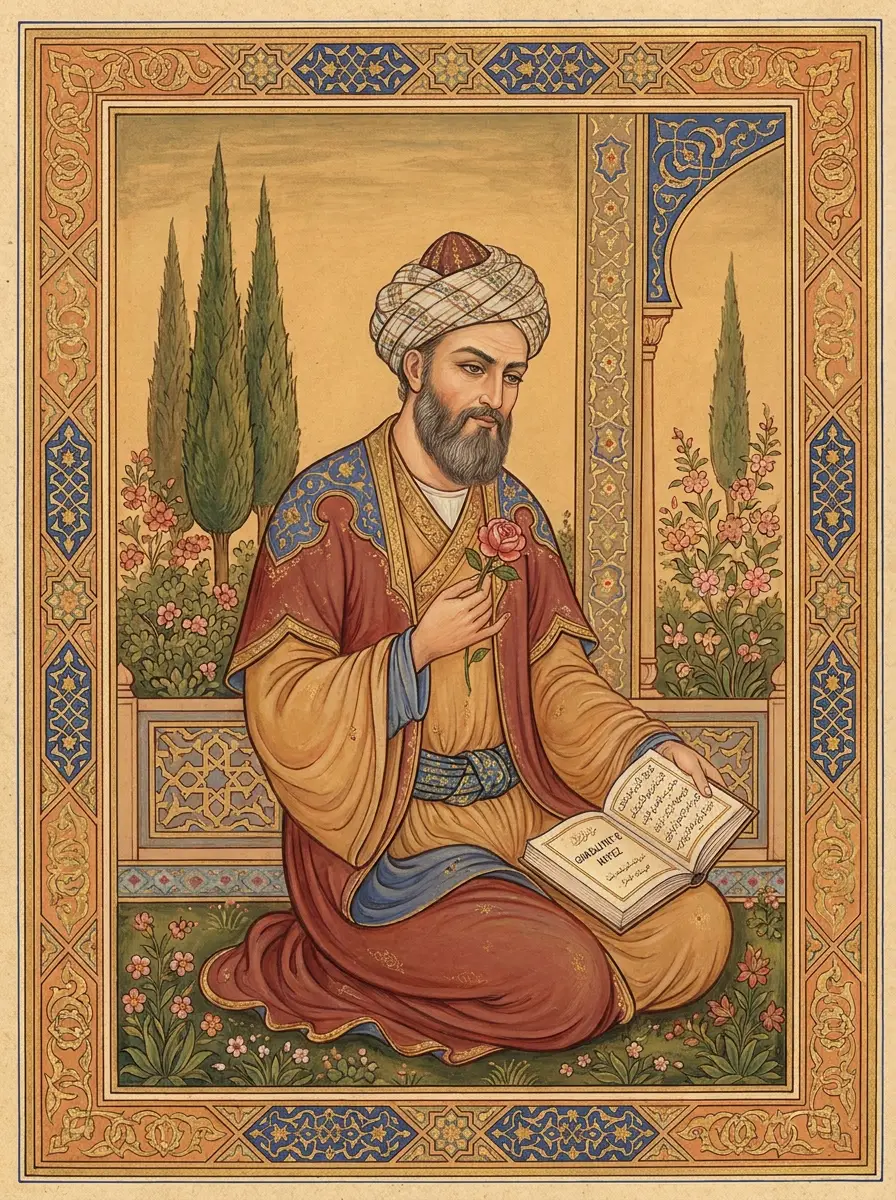
Hafez
The celebrated Persian lyric poet (c. 1325–1390) from Shiraz whose Divan is among the most beloved works of Persian literature and used for bibliomancy (fal).
Read in context →Biography
Khwaja Shams al-Din Muhammad Hafez of Shiraz (c. 1315–1390) was a lyric poet whose Divan — a collection of several hundred ghazals — is widely regarded as the summit of the Persian lyric tradition. His verse fuses themes of love, wine, mystical longing, and sharp critique of religious hypocrisy in a style prized for an ambiguity that sustains both worldly and Sufi readings. He took the pen name 'Hafez' (one who has memorized the Qur'an) and lived under the Injuid and Muzaffarid dynasties, enjoying intermittent courtly patronage. Reliable biographical detail is scarce — the early tazkiras are considered largely anecdotal and unreliable, so most 'facts' about his life are cautiously reconstructed from his poems — and even his dates are disputed (birth 1315 or 1317, death 1389 or 1390). His Divan remains a beloved fixture of Iranian culture, still used for bibliomancy (fāl-e Hāfez).
Quotes & narrations
«If that Shirazi Turk would take my heart in hand, for the mole on her cheek I would give away Samarkand and Bukhara.»
«O cup-bearer, pass round and offer the cup; for love seemed easy at first, but difficulties have arisen.»
Related entities
Also appears in
Sources
- Encyclopaedia Iranica, "Hafez ii. Hafez's Life and Times"
- Encyclopaedia Britannica, "Hafez"
- Moḥammad Moʿin and Qāsem Ḡani (on the disputed dates)