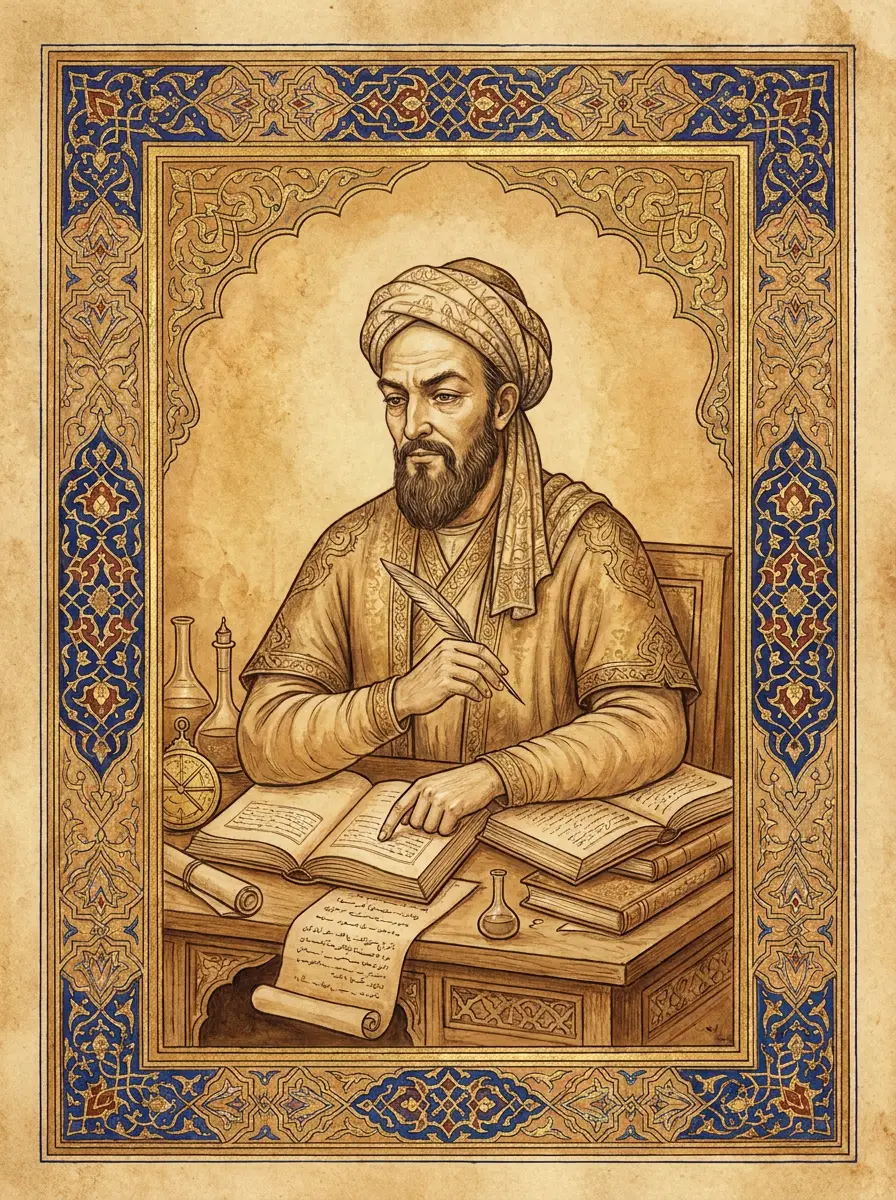
Avicenna (Ibn Sina)
The great Persian philosopher and physician (c. 980–1037), author of the Canon of Medicine and the Book of Healing, among the most influential scholars of the Islamic and medieval worlds.
Read in context →Biography
Abu Ali al-Husayn ibn Sina (c. 980–1037), known in Latin Europe as Avicenna, was a Persian polymath born near Bukhara (then in the Samanid realm, today Uzbekistan) and the preeminent philosopher-physician of the Islamic Golden Age. A prodigy who served as court physician and administrator to a succession of Iranian rulers, he authored over 250 works. His medical encyclopedia, al-Qanun fi'l-Tibb (The Canon of Medicine), systematized Greco-Islamic medicine and was used as a standard textbook in Europe and the Islamic world into the early modern period, while his philosophical summa al-Shifa (The Cure) decisively shaped both Islamic philosophy and European Scholasticism, especially debates on essence, existence, and the soul. He notably anticipated ideas about contagion and the isolation of the sick. A long-debated point is his religious-philosophical positioning: his Neoplatonized Aristotelianism drew the sustained critique of al-Ghazali, making him a touchstone in the rationalism-versus-revelation debate.
Quotes & narrations
«Whatever exists is either necessary in itself or contingent; and the Necessary Being is the cause of all contingents.»
Related entities
Also appears in
Sources
- Internet Encyclopedia of Philosophy, "Avicenna (Ibn Sina)"
- Encyclopaedia Iranica, "Avicenna"
- Encyclopaedia Britannica, "Avicenna"