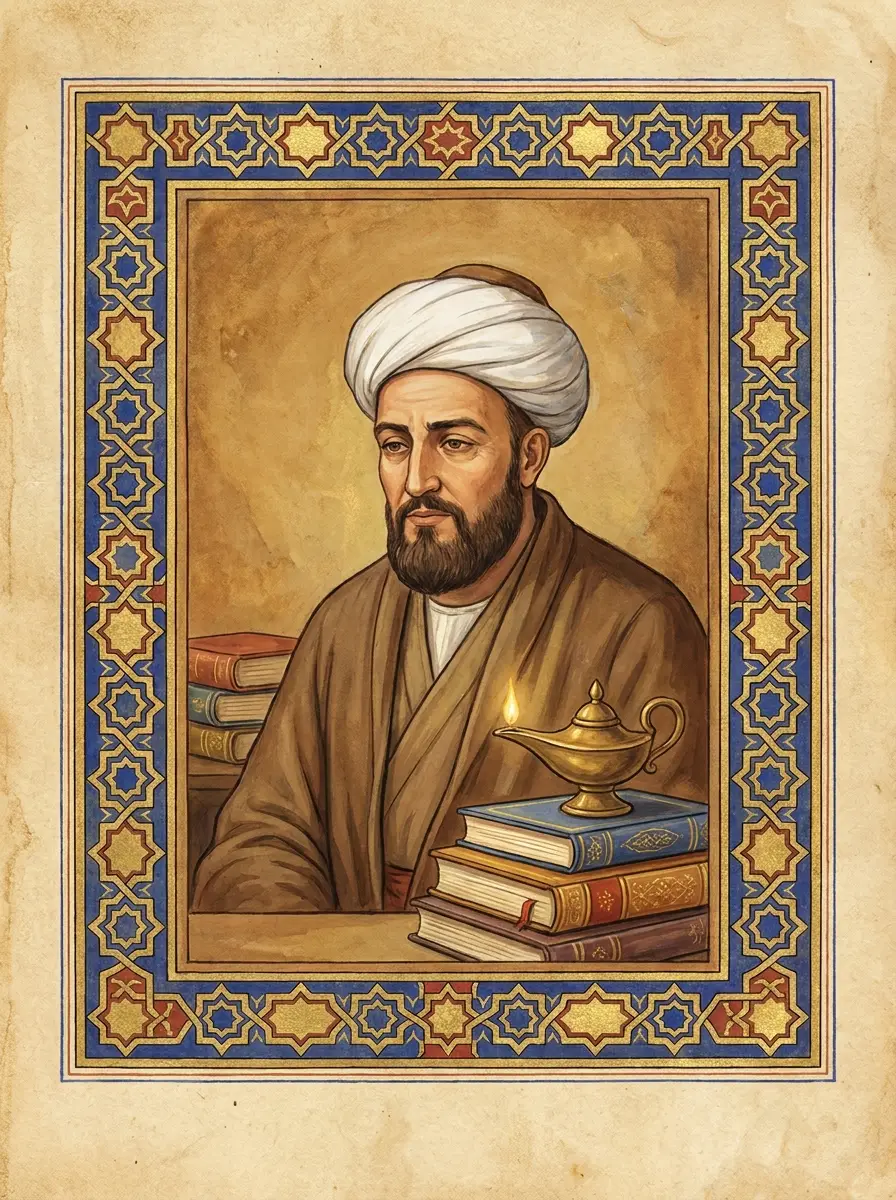
Al-Ghazali
The Persian Sunni theologian, jurist, and mystic (c. 1058–1111) whose 'Revival of the Religious Sciences' and critique of philosophy profoundly shaped Islamic thought.
Read in context →Biography
Abu Hamid Muhammad al-Ghazali (c. 1058–1111) was a Persian Sunni theologian, Shafi'i jurist, philosopher, and Sufi born in Tus, Khorasan. Trained under the leading Ash'ari theologian al-Juwayni at Nishapur, he was appointed in 1091 to the prestigious Nizamiyya madrasa in Baghdad, becoming one of the most influential scholars of his age. Around 1095 he underwent a profound spiritual crisis, abandoned his chair, and spent years in retreat and Sufi practice — an episode he recounts in his spiritual autobiography al-Munqidh min al-Dalal (Deliverance from Error). His magnum opus, Ihya' Ulum al-Din (Revival of the Religious Sciences), integrated law, ethics, and Sufi spirituality, while his Tahafut al-Falasifa (The Incoherence of the Philosophers) attacked Avicennian metaphysics — especially on the eternity of the world, God's knowledge of particulars, and bodily resurrection. A long-debated nuance is whether his critique 'halted' philosophy in the Islamic world (an older Orientalist thesis now widely contested) or instead absorbed and redirected its tools; he was famously answered by Averroes (Ibn Rushd).
Quotes & narrations
«Knowledge without action is madness, and action without knowledge is misguidance.»
Related entities
Also appears in
Sources
- Stanford Encyclopedia of Philosophy, "al-Ghazali"
- Encyclopaedia Britannica, "al-Ghazali"
- Routledge Encyclopedia of Philosophy, "al-Ghazali, Abu Hamid (1058–1111)"