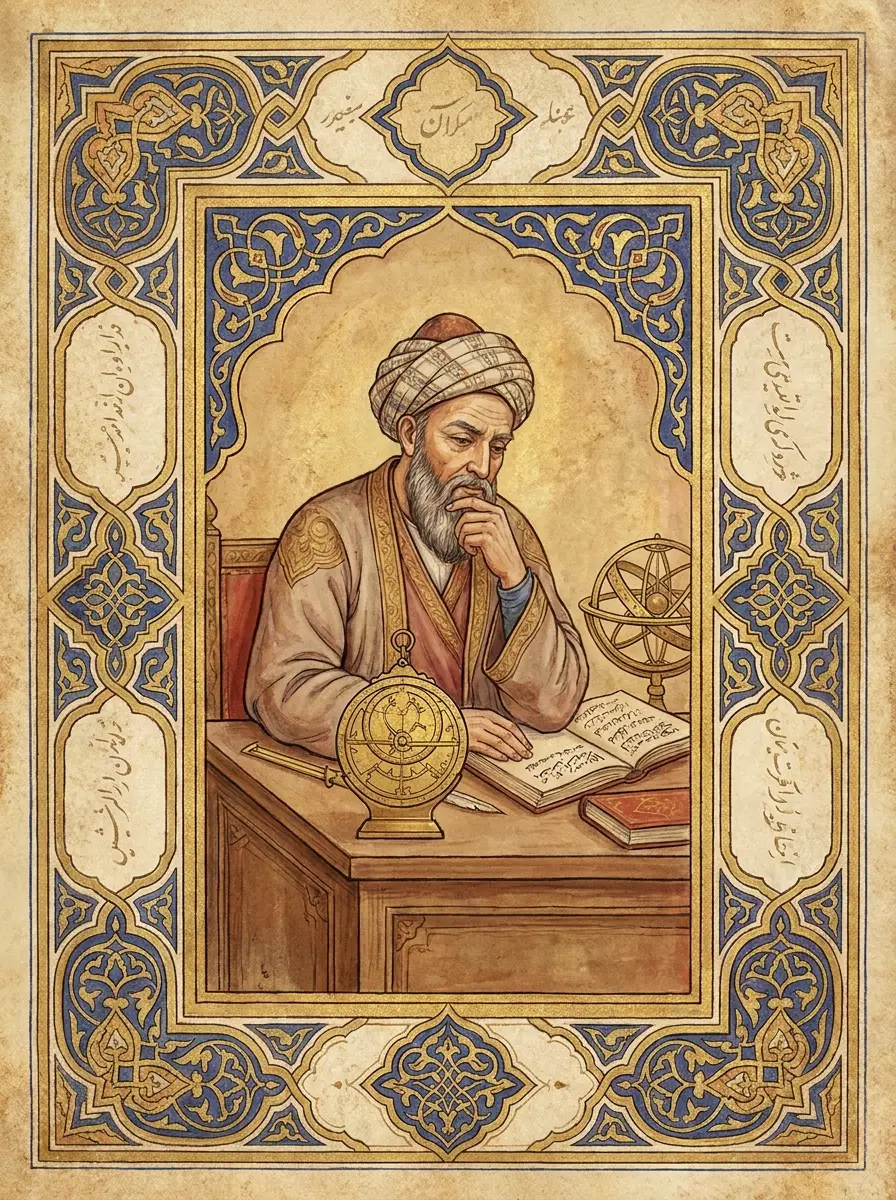
Omar Khayyam
The Persian poet, mathematician, and astronomer (1048–1131) famed for his philosophical quatrains (rubaiyat) and scientific work, including calendar reform.
Read in context →Biography
Ghiyath al-Din Abu'l-Fath Omar ibn Ibrahim al-Khayyam (1048–1131) was a Persian polymath from Nishapur, renowned in his own lifetime not as a poet but as a mathematician and astronomer. He wrote one of the most important pre-modern treatises on algebra, advancing the geometric solution of cubic equations, and was summoned by the Seljuk sultan Malik-Shah to reform the calendar, producing the highly accurate Jalali calendar. He is known in the West chiefly through the Rubaiyat, a collection of skeptical, epicurean quatrains popularized by Edward FitzGerald's free 1859 English adaptation. A major scholarly controversy concerns authenticity: the quatrains circulated anonymously and orally, none securely datable to his lifetime, and over a thousand later accreted under his name, so estimates of which verses are genuinely his vary widely.
Quotes & narrations
«O friend, come, let us not grieve over tomorrow; let us count this single breath of life as a treasure.»
«This jug, like me, was once a lover in lament; it too was caught in the tresses of some beloved.»
Related entities
Also appears in
Sources
- Encyclopaedia Britannica, "Omar Khayyam"
- MacTutor History of Mathematics, "Omar Khayyam"
- Ali Dashti, In Search of Omar Khayyam (1971)