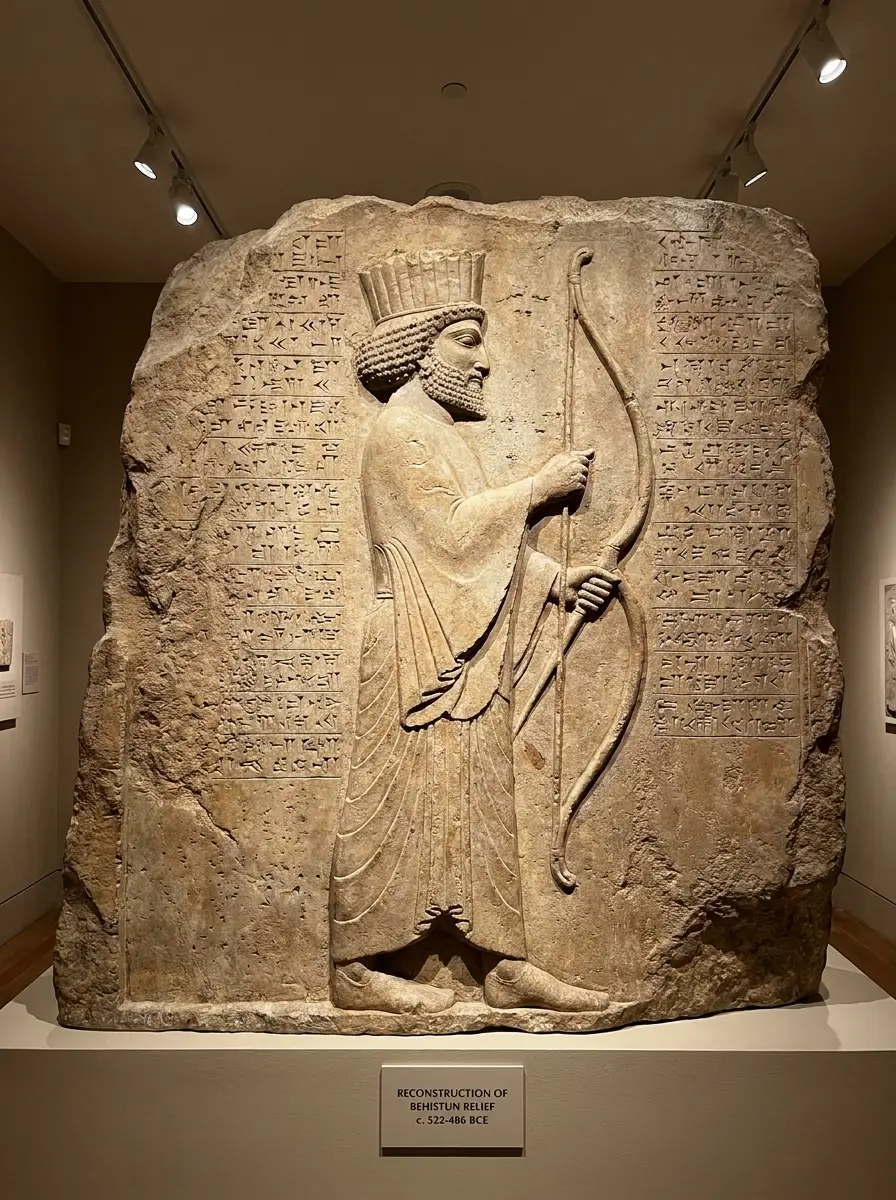
Darius I
Achaemenid king (c. 550–486 BCE) who brought the empire to its greatest extent, established the satrapy system and the Royal Road, and began building Persepolis.
Read in context →Biography
Darius I, called Darius the Great (c. 550–486 BCE), was the third Achaemenid king, seizing power in 522 BCE after killing the alleged usurper Gaumata. After suppressing widespread revolts, he reorganized the empire into satrapies with standardized taxation, gold coinage (the daric), the Royal Road, and a postal system. He extended the empire to its greatest reach and began the palace complex at Persepolis, though his invasion of Greece ended in defeat at Marathon (490 BCE); his Behistun inscription later enabled the modern decipherment of cuneiform. A central contested point is that Darius's own account of his rise — that Gaumata was an impostor magus — is propaganda recorded by the victor, and many scholars suspect Darius was himself a usurper who fabricated the impostor story.
Quotes & narrations
«By the favour of Ahuramazda I am of such a sort that I am a friend to right, not to wrong. It is not my wish that the weak should have wrong done by the mighty, nor that the mighty should suffer wrong by the weak.»
«Ahuramazda, when he saw this earth in commotion, bestowed it upon me, made me king.»
Related entities
Also appears in
Sources
- Encyclopaedia Iranica, "Darius iii. Darius I the Great"
- Rüdiger Schmitt, The Bisitun Inscriptions of Darius the Great
- Encyclopaedia Britannica, "Darius I"