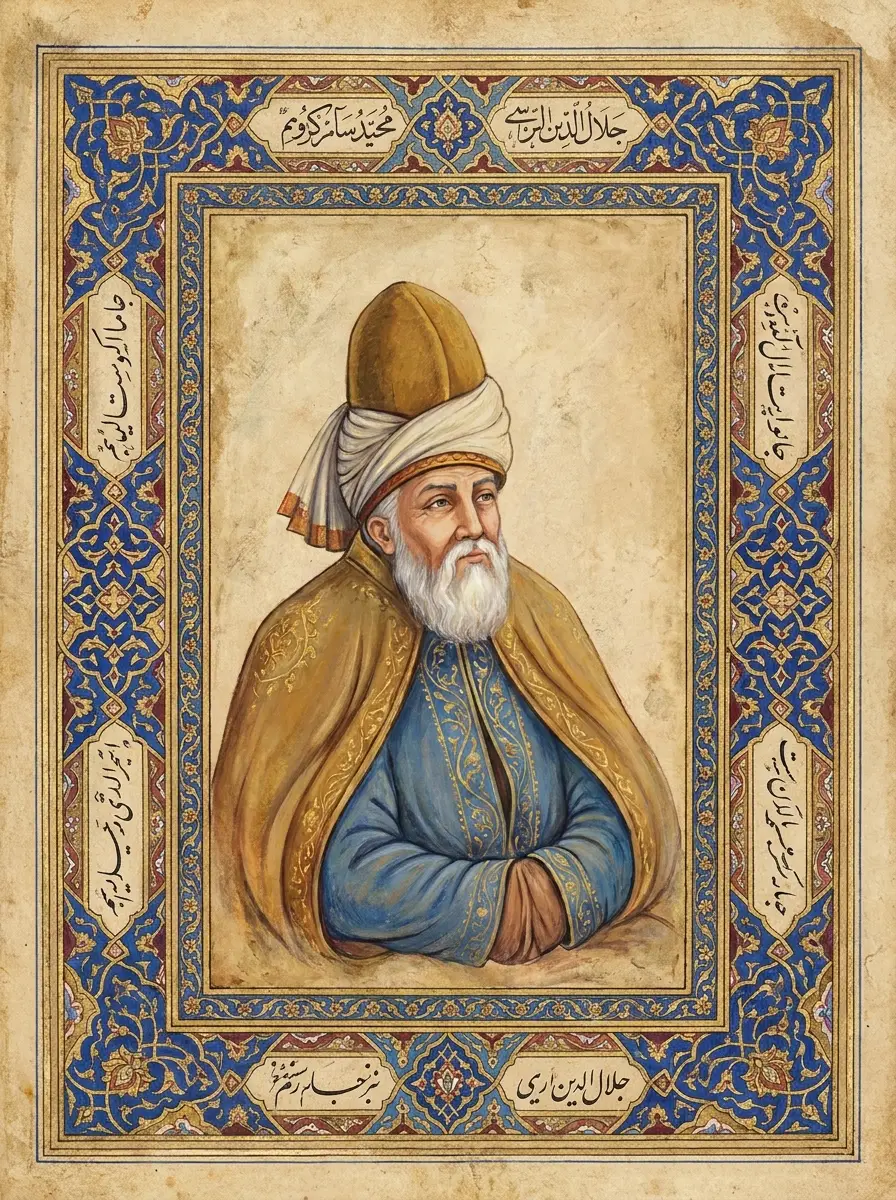
Rumi
The great Persian poet and mystic (1207–1273), author of the Masnavi, among the most influential figures in world literature and Sufism.
Read in context →Biography
Jalal al-Din Muhammad Rumi, known as Mowlana and Rumi (1207–1273), was a Persian-language poet, jurist, and Sufi mystic whose family originated in Balkh and migrated westward (c. 1218) ahead of the Mongol advance, eventually settling in Konya in Anatolia (Rum, hence 'Rumi'). He succeeded his father as a religious teacher, but his life was transformed around 1244 by his encounter with the wandering dervish Shams-e Tabrizi, which catalyzed his turn to ecstatic poetry. His major works are the Masnavi-ye Maʿnavi (some 25,000 couplets of didactic mystical narrative, dictated to his disciple Hosam al-Din) and the lyrical Divan-e Shams-e Tabrizi, and he inspired the Mevlevi ('whirling dervish') order founded by his followers after his death. A contested modern point is his cultural 'ownership' — Iran, Turkey, and Afghanistan each claim him — and his popular Western image often downplays the Islamic and Qur'anic grounding of his work.
Quotes & narrations
«Listen to this reed, how it complains; it tells a tale of separations.»
«Come, come, whoever you are, come; though you be an unbeliever, a fire-worshipper, or an idolater, come.»
Related entities
Also appears in
Sources
- Encyclopaedia Iranica, "Rumi, Jalāl-al-Din"
- Encyclopaedia Britannica, "Rumi"
- Franklin Lewis, Rumi: Past and Present, East and West (2000)