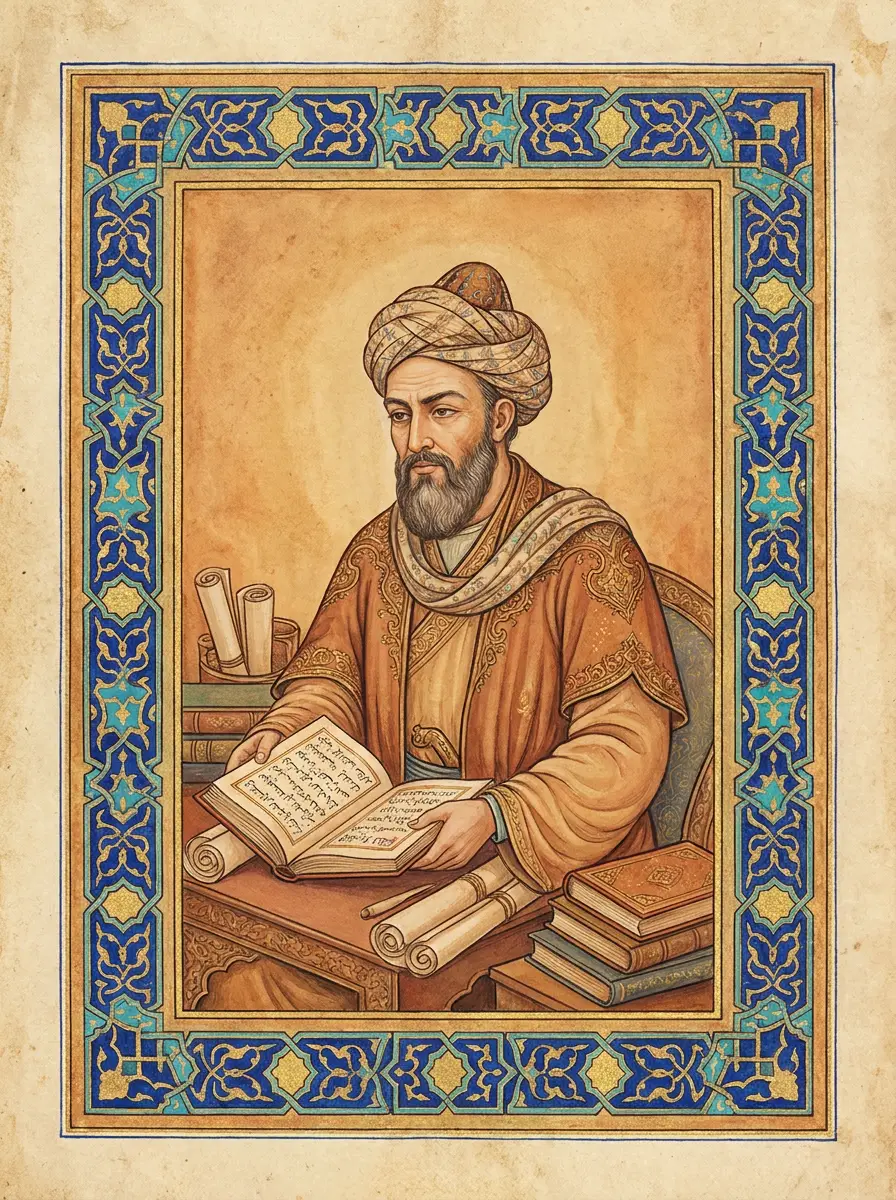
Mulla Sadra
The leading Iranian philosopher of the Safavid era (c. 1571–1640), founder of 'Transcendent Theosophy' (hikmat muta'aliya), synthesizing philosophy, mysticism, and Shia theology.
Read in context →Biography
Sadr al-Din Muhammad ibn Ibrahim al-Shirazi, known as Mulla Sadra (c. 1571/2–1640/1), was a Persian Shi'i philosopher, theologian, and mystic of the Safavid period, generally regarded as the most important Islamic metaphysician after Avicenna. Born in Shiraz, he studied in Isfahan under teachers including Mir Damad and Shaykh Baha'i, then withdrew for years of ascetic retreat near Qom before returning to teach. His monumental al-Asfar al-arba'a ('The Four Journeys') expounds his system, al-hikma al-muta'aliya ('transcendent theosophy'), which synthesizes Avicennan philosophy, Suhrawardi's Illuminationism, Ibn Arabi's Sufi metaphysics, and Twelver Shi'i theology. His signature doctrines are the primacy of existence (asalat al-wujud) over essence and substantial motion (al-haraka al-jawhariyya), the idea that a substance's very being undergoes continuous change. A point of scholarly attention is his uneasy relationship with the orthodox clerical establishment of his day, which viewed his philosophical mysticism with suspicion; his influence on later Iranian thought (down to the modern hawza and figures such as Khomeini) is considerable, though it was slower to be recognized in the West.
Quotes & narrations
«Reality belongs to existence, not to quiddity; existence is a single reality admitting of gradation (tashkik).»
Sources
- Stanford Encyclopedia of Philosophy, "Mulla Sadra"
- Seyyed Hossein Nasr, Sadr al-Din Shirazi and His Transcendent Theosophy (1978)
- Encyclopaedia Iranica, "Mulla Sadra"