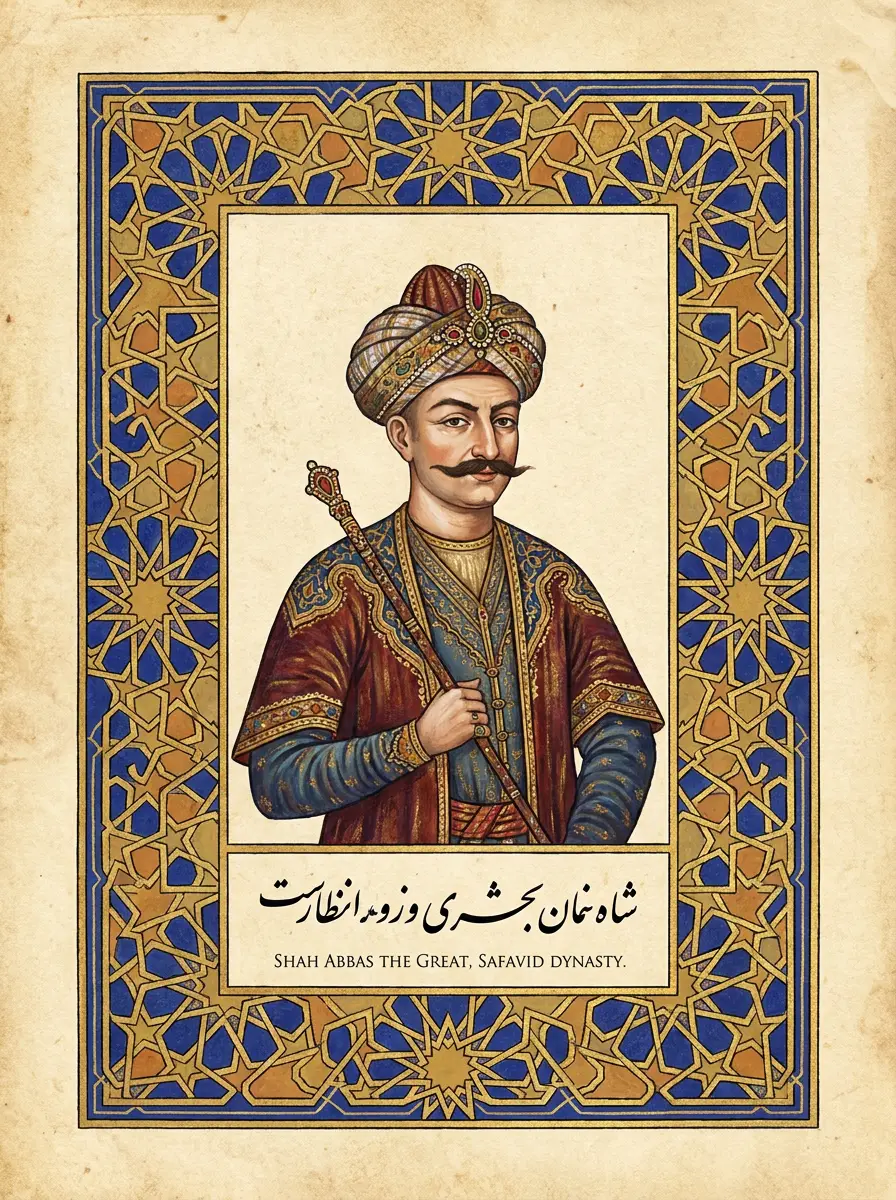
Shah Abbas I
The greatest Safavid ruler (r. 1588–1629), who moved the capital to Isfahan, reformed the army, and presided over the golden age of Safavid art and architecture.
Read in context →Biography
Abbas I, Abbas the Great (1571–1629), the fifth Safavid shah, came to the throne in 1588 amid Ottoman and Uzbek encroachment and Qizilbash factionalism, and is generally regarded as the dynasty's most capable ruler. He curbed the unruly Qizilbash by building a standing army of ghulams (slave-soldiers, largely of Caucasian origin) equipped with firearms and artillery, then expelled Ottoman and Uzbek forces and recovered lost territory. In 1598 he moved the capital from Qazvin to Isfahan, which he rebuilt into one of the world's most magnificent cities centered on the Naqsh-e Jahan square, and he promoted trade (notably the silk monopoly and ties with Europe), the arts, and architecture. A contested point is that Abbas secured his rule through ruthless dynastic violence — blinding or killing several of his own sons and kinsmen — which strengthened his reign but contributed to a weakened succession after him.
Quotes & narrations
«Isfahan is half the world. (a proverb tied to the flourishing of Shah Abbas's capital)»
Related entities
Sources
- Roger Savory, Iran under the Safavids
- Encyclopaedia Iranica, "ʿAbbās I"
- Eskandar Beg Monshi, Tarikh-e ʿAlam-ara-ye ʿAbbasi (trans. Savory)