The Boy Who Became Shah — Ismail and the Qizilbash
In the winter of 1501, a youth of thirteen or fourteen stood before the gates of Tabriz. His name was Ismail, the last survivor of a Sufi house from Ardabil whose forebears, Shaykh Safi al-Din and his successors, had transformed a mystical order into a militant military movement. His Turkmen disciples, gathered from Anatolia, northern Syria, and Azerbaijan, wore a red cap with twelve folds — a token of devotion to the twelve Imams — and for this reason came to be called "Qizilbash," meaning red-heads. They regarded Ismail not only as a commander but as the perfect spiritual master, and even as a manifestation of the divine.
With this devoted army, Ismail within a few years gathered the Iranian plateau — for a century scattered among the Aq Qoyunlu Turkmen and local rulers — under a single banner. He composed poetry in Turkish — under the pen name "Khatai" — and in those verses sometimes praised himself in language that was exaggerated and charged with millenarian fervor. The question is what to call this project: an Iranian uprising to revive a centralized state, or a Turkmen religious wave with a messianic coloring? The answer, as we shall see, is both and neither alone.
The Fateful Decree — Shiism as the State
In his first sermon as sovereign in Tabriz, Ismail proclaimed Twelver Shiism the official religion of his realm. This decision was made in a land whose majority in those days were Sunni — chiefly Shafiʿi and Hanafi — and whose strong Shia centers of learning lay mostly in Jabal Amel in Lebanon, in Bahrain, and in Iraq, rather than in the heart of the plateau. The consequence of this decree reached beyond the bounds of religion: it set Iran apart as a confessional island amid its Sunni neighbors — the Ottomans to the west and the Uzbeks to the east — and raised a wall of belief that has cast its shadow over Iranian identity down to our own time.
So that this newly official faith might take root, the Safavids were compelled to summon Shia scholars from Jabal Amel, Iraq, and Bahrain to Iran; they built seminaries, granted endowments, and created a religious hierarchy that had not previously existed in Iran on such a scale. But the other side of this transformation was pressure, and at times violence: the open prohibition and cursing of the first caliphs from the pulpits, and severity toward those who refused to embrace the new faith. How gradual and how coercive this conversion of a nation was remains one of the most contested questions in Iranian history.
Chaldiran — The Thunder of Cannon and the End of the Myth of Invincibility
The fervor and glory of the Qizilbash rose to such a height that their collision with the Ottoman Empire became inevitable. The Ottomans, who regarded themselves as defenders of Sunni tradition and were alarmed by the influence of Safavid propaganda among the Anatolian Turkmen, undertook a bloody suppression of Ismail's followers. In August 1514, the two armies faced one another on the plain of Chaldiran, in the northwest of Iran.
On that field, two worlds confronted each other: the brave but poorly equipped Qizilbash cavalry, which had set its heart on sword and faith, and the disciplined Ottoman army, furnished with artillery and Janissary musketeers. The roar of the cannon tore through the Qizilbash ranks. Ismail himself was wounded and barely escaped with his life. In territorial terms Chaldiran was not an unmitigated catastrophe — the Ottomans were unable to remain — but its psychological wound ran deep: the belief in the invincibility of the master and his army collapsed. It is said that after that defeat Ismail never again went to battle in person.
Shah Abbas and the Taming of the Red Lions
The decades after Ismail were pregnant with strife: the Qizilbash tribes, once the pillar of the state, now turned to rivalry over power and plunged the country into turmoil. In the midst of this, in 1588, a young man named Abbas ascended the throne who was destined to become the greatest king of this dynasty.
Abbas understood that until the willful power of the Qizilbash was curbed, the central government would not breathe easily. He raised up a new force: the "ghulams" — soldiers, many of Georgian, Armenian, and Circassian origin, who were trained in the administrative and military apparatus and whose loyalty was directly to the person of the shah, not to a tribe. With the help of this force and the formation of musketeer regiments and artillery in the new style, Abbas turned the balance of power in favor of the crown, pushed back the Ottomans and the Uzbeks, and recovered the lost territories.
Isfahan, Half the World
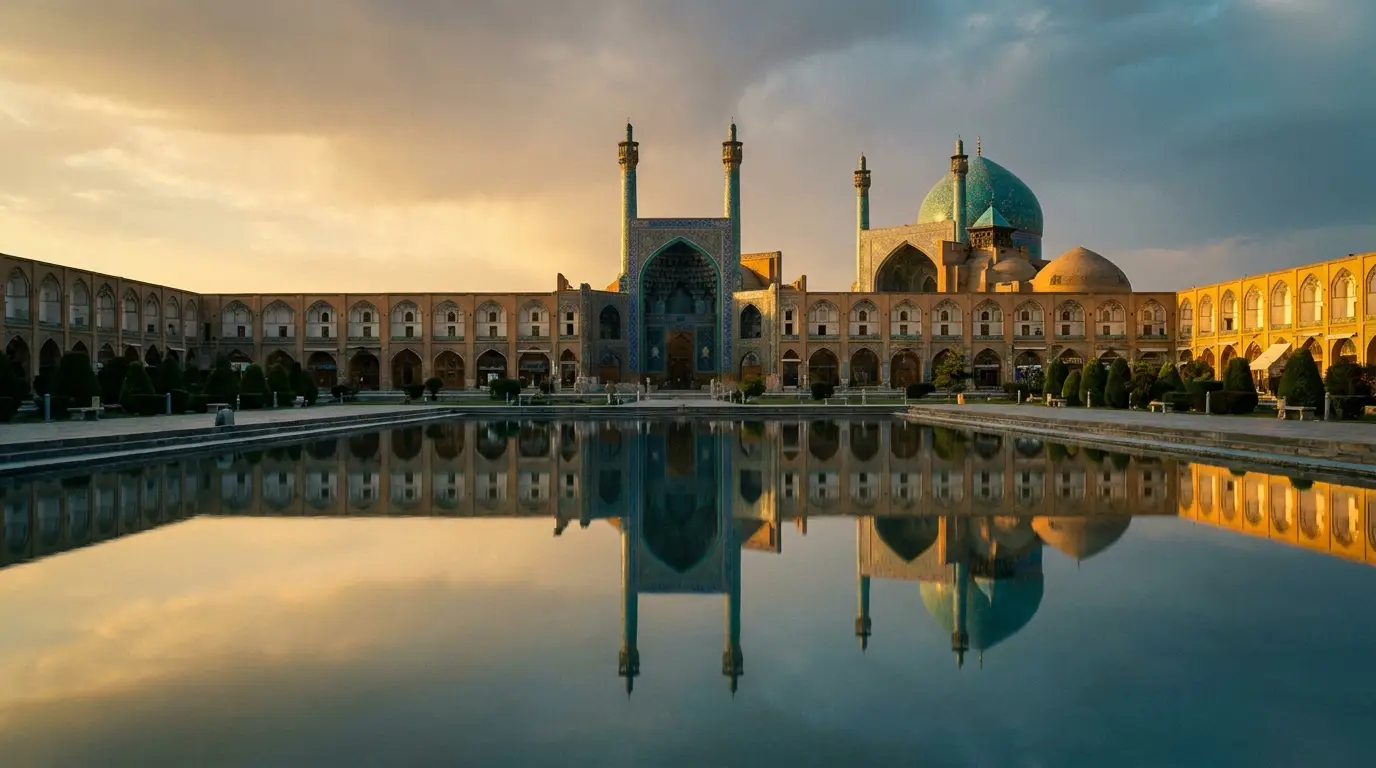
Shah Abbas moved the capital to Isfahan and transformed it into one of the most magnificent cities of the world of that age. In the heart of the city arose the great square of "Naqsh-e Jahan"; a vast quadrangle around which were set the Shah Mosque with its lapis-blue tiles, the delicate Shaykh Lutfallah Mosque, the portal of the great bazaar, and the Ali Qapu palace. The garden avenue of Chaharbagh, the eye-pleasing bridges of the Zayandeh River, and the caravanserais gave the city a face that became the talk of travelers; a proverb arose that called Isfahan "half the world."
Abbas also put the country's economy in order. He effectively brought the silk trade of the north under a state monopoly and resettled the experienced Armenian community from Julfa into a new quarter of Isfahan — New Julfa — so that their commercial network might carry the silk revenue to Europe and India. Ambassadors and travel writers such as Chardin and della Valle came to his court; Iran, after centuries, once again became a player in world diplomacy. The art of this era — painting, calligraphy, carpets, and architecture — reached a peak that is still a symbol of the splendor of Safavid Iran.
The Twilight of the Safavids and the Afghan Onslaught
After Abbas, the splendor gradually faded. The custom of keeping the princes in the "harem," far from the work of government, produced successors who were inexperienced and at times incapable. The bureaucracy grew bloated, the land tax weighed heavily on the peasants, and religious severity toward the minorities and the Sunni Afghans of Kandahar stirred discontent.
In 1722, a band of Ghilzai Afghans of Kandahar, led by Mahmud, exploited this weakness, struck into the heart of Iran, and after a long siege and a horrific famine took Isfahan. Shah Sultan Husayn lifted the crown from his head and surrendered. The fall of that splendid capital sent a tremor through the body of Iran and ushered in an age of chaos and fragmentation.
Nader — A Sword from Khorasan to Delhi
Out of this turmoil rose a ruthless and brilliant commander: Nader, of the Afshar tribe in Khorasan. He first, in the name of the Safavid remnants, drove out the Afghans, pushed the Ottomans and Russians back from the occupied lands, and then in 1736 placed the crown upon his own head. Nader was the last great Asian conqueror of the old style; his campaign into India in 1739 and the capture of Delhi were accompanied by a dreadful massacre and the plunder of the Mughal treasuries. He brought the "Peacock Throne" and the legendary diamonds to Iran.
Nader was unrivaled on the field of battle, but in governance and religious reconciliation he failed. He attempted, with a scheme called the "Jaʿfari" school, to bridge the rift between Shia and Sunni — an effort that neither the Ottomans accepted nor the Shia clergy went along with. His final years passed in suspicion, unbridled violence, and back-breaking taxes, until at last in 1747 he was killed by his own commanders and his empire collapsed in an instant.
Karim Khan — A Brief Calm in Shiraz
After the storm of Nader, a man of the Zand tribe, Karim Khan, rose in the south of Iran and brought a relative calm. Calling himself not "shah" but "Vakil al-Raʿaya" — representative of the people — he made Shiraz the capital and adorned it with gardens, a covered bazaar, a mosque, and a beautiful citadel. The accounts have made of him a rare figure among the rulers of that age: a man relatively close to the people and concerned with the prosperity and ease of his subjects.
But this calm was tied to the life of Karim Khan himself. With his death in 1779, strife over succession broke out once more, and the way was opened for the rise of a new dynasty — the Qajars. Even so, the great legacy of the Safavids endured: an Iran that had made Shiism a pillar of its identity, found borders more or less familiar, and engraved upon its mind the memory of a splendor to which, in later centuries, it would return again and again.
⚖ Contested points
- The speed and degree of violence of Iran's Shiification is a matter of dispute: some regard it as a transformation that was largely coercive and rapid, imposed from above; others emphasize its gradual character over generations, the role of the migration of the Jabal Amel scholars, and the existence of prior groundwork of Shiism and Alid Sufism in Iran.
- The nature of Ismail's project is likewise a matter of debate: was it a "national" uprising to revive a centralized state, or a religious-millenarian movement with a Turkmen core, driven by Sufi devotion and messianic beliefs? Many historians regard the later "nationalist" reading as a projection of modern concepts onto a movement of the tenth century of the Hijra.
Sources
- Encyclopædia Iranica — «Safavid Dynasty», «Esmāʿil I», «Čālderān», «ʿAbbās I», «Nāder Shah»
- R. M. Savory, Iran under the Safavids
- H. R. Roemer, The Cambridge History of Iran, vol. 6
- Rudi Matthee, Persia in Crisis
- Encyclopædia Britannica — «Safavid Dynasty», «ʿAbbas I», «Nader Shah», «Karim Khan Zand»