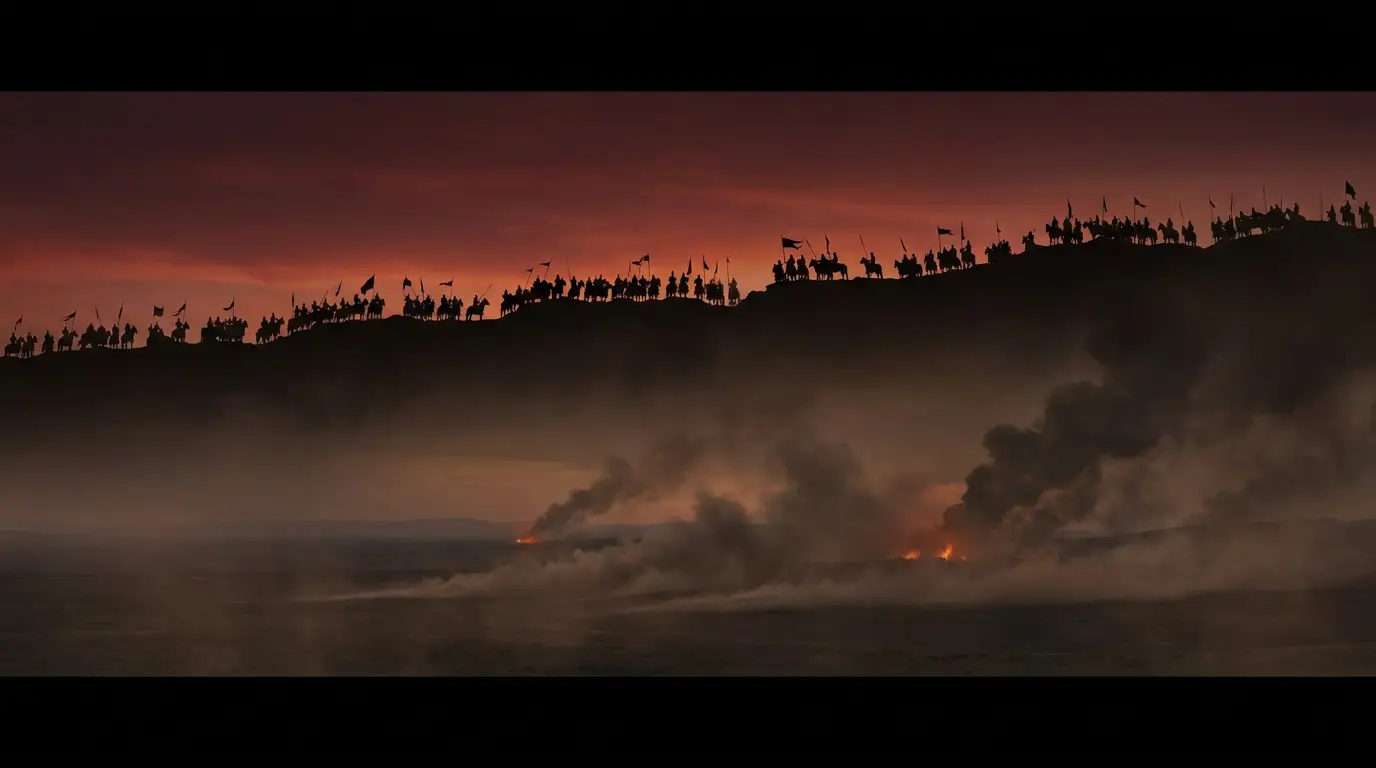
Prelude: The Seljuks, Nizam al-Mulk, and the Fortress of Alamut
Before the storm rose from the east, Iran breathed beneath the shadow of the Seljuk Turks: a nomadic people who poured out of Central Asia in the fifth century of the Hijra and built a vast realm stretching from the borders of China to the Mediterranean. The soul of this dominion beat not in the sultan's sword but in the pen of a Persian vizier: Khwaja Nizam al-Mulk of Tus. In his «Siyasatnama» (Book of Government) he fused the ancient Iranian ideal of just rulership with Islamic law, and founded a network of colleges—the Nizamiyya—in Baghdad, Nishapur, and other cities.
In that same age, in the heart of the Alborz mountains, another movement arose: the Nizari Ismailis, led by Hasan-i Sabbah, who seized the fortress of Alamut in 483 AH. They did not seek to contend with the Seljuks on the open field of battle; their weapon was the targeted assassination of grandees—a method that left the name «Assassins» in the European languages, though the origin and accuracy of that label are themselves matters of dispute. The famous account holds that Nizam al-Mulk himself fell in 485 AH to the blade of one of Alamut's devotees.
The Storm from the East: Genghis Khan and the Reduction of Khurasan to Ash
At the opening of the seventh century of the Hijra, the mighty ruler of the Khwarazmian empire, Sultan Muhammad, held sway over much of Iran. But beyond the frontiers, on the steppes of Mongolia, a man had gathered the scattered tribes beneath a single banner: Temujin, now called Genghis Khan. What kindled the fire was a commercial incident; a caravan of merchants affiliated with the Mongols was accused of espionage and killed at the frontier town of Otrar on the orders of the Khwarazmian governor. Genghis sent an envoy and demanded justice; the Khwarazmshah's answer was to kill the envoy—a spark that led to the conflagration of a civilization.
Around 616 AH (1219 CE), the Mongol army crossed the Oxus. The cities fell one after another: Bukhara, Samarkand, and then the heart of eastern Iranian civilization, Khurasan. Nishapur, Merv, and Herat—that brilliant triad of learning and prosperity—were turned to ruins. The intricate system of qanat irrigation collapsed in many places, inflicting a wound upon the body of this land that took generations to heal.
On the Number of the Slain: A Necessary Caution
The medieval chroniclers have left behind, regarding the Mongol slaughter, figures that make the mind reel; they said that in Nishapur or Merv hundreds of thousands, and sometimes more than a million, were killed. But modern scholars regard these numbers with great caution. The population of those cities in that era did not reach figures that would make such massacres numerically possible; and the old historiographical tradition was concerned more with conveying the magnitude of the catastrophe and its moral lesson than with precise enumeration.
It is therefore more accurate to say that the devastation was deep and real—cities burned, fields lay fallow, and a wave of displacement and famine arose—but the precise number of the slain is unknown and most probably exaggerated. This distinction is drawn not to diminish the weight of the calamity, but in fidelity to documented truth.
Hulagu: The Fall of Alamut and the End of the Baghdad Caliphate
Two generations after Genghis, his grandson Hulagu Khan was charged with completing his grandfather's unfinished work in the west. The first target was those same impregnable Ismaili fortresses. In 654 AH (1256 CE) Alamut—a castle that had remained unconquered for nearly a century and a half—surrendered, and its renowned library was largely destroyed; though it is said that Khwaja Nasir al-Din al-Tusi managed to rescue part of its scientific heritage.
Then came the turn of Baghdad, seat of the Abbasid Caliphate. In 656 AH (1258 CE) the city was besieged and at last fell. The last Abbasid caliph, al-Musta'sim, was killed, and with him perished an institution that for more than five hundred years—at least in name—had been reckoned the spiritual center of the Sunnis. This event left a deep wound in the historical memory of the Muslims.
A Paradoxical Flowering: The Ilkhanate and the Maragha Observatory
Remarkably, from the heart of this very devastation there arose a state that ultimately took on the color of Iran: the Ilkhanate. The pagan and Buddhist conquerors, generation by generation, dissolved into the culture and religion of the conquered land. The turning point came in 694 AH, when Ghazan Khan converted to Islam and carried out sweeping reforms in the bureaucracy, taxation, and coinage in order to rebuild the ruined economy. The invading Mongols, in a rare historical reversal, became the patrons of Iranian civilization.
In this same period, Khwaja Nasir al-Din al-Tusi founded an observatory at Maragha that became one of the most important astronomical centers in the world and produced the «Ilkhanid Zij» (astronomical tables). The learned vizier, Rashid al-Din Fadlullah Hamadani, wrote the «Jami al-Tawarikh»—a work that has been called the first true «world history». The newly founded city of Soltaniyeh, with its colossal dome, became witness to the fact that the Iranian phoenix spreads its wings even from amid the ashes.
Timur: Towers of Skulls and a Golden Age of Art
After the collapse of the Ilkhanate, Iran sank into a patchwork of petty principalities until another conqueror arose from Central Asia: Timur the Gurkani, whom the Europeans called Tamerlane. At the close of the eighth century of the Hijra, he launched devastating campaigns that ranged from India to Anatolia and Syria. The accounts speak of minarets raised from the heads of the slain in cities such as Isfahan; an image that has bound his name to terror and bloodshed.
Yet this same man turned his own capital, Samarkand, into a jewel-house of architecture and raised palaces and mosques tiled in turquoise faience. This contradiction—destruction in one city and construction in another—is the essence of the enigma of Timur. His image among historians remains a matter of dispute: was he above all a ruthless conqueror, or a great patron of art and civilization? Perhaps the truth is that he was both.
Herat, Jami, and Hafez of Shiraz: The Phoenix Rises
Timur's legacy was raised by his successors—the Timurids—to an artistic zenith that few would have expected to emerge from amid all that bloodshed. Herat, in the age of Shahrukh and Gawhar Shad and then Sultan Husayn Bayqara, became the beating heart of Iranian culture. The Herat school of painting, with artists who brought the art of the miniature to the height of refinement, was the creator of masterpieces that still dazzle the eye. In this same circle lived Abd al-Rahman Jami, who has been deemed the last great summit of classical Persian poetry.
And on another side of this turmoil-stricken land, Shiraz, through the sagacity of its local rulers, had largely been spared direct devastation. In this very city, in the middle of the eighth century of the Hijra, Khwaja Shams al-Din Muhammad, Hafez of Shiraz, composed ghazals that made the Persian language immortal. His poetry, a blend of passion, roguish wit, and wisdom, was born in an age of instability and violence—as though the soul of Iran, on its darkest nights, created its brightest stars. This is the theme of this chapter: devastation and an unbelievable rebirth; a phoenix that rises, each time, from its own ashes.
⚖ Contested points
- The number of those slain in the Mongol invasion of the cities of Khurasan: the figures of the medieval chroniclers—hundreds of thousands to more than a million—are, in the view of modern scholars, severely exaggerated and unverifiable, since they do not accord with the demographic estimates of that era; the devastation was real and deep, but the numbers are imprecise.
- The historical image of Timur: historians disagree as to whether he should be regarded above all as a destructive conqueror or a great patron of art; both aspects are documented, and emphasis on one alone yields an incomplete picture.
Sources
- Encyclopaedia Iranica — «Mongols», «Hülegü Khan», «Ḡāzān Khan», «Rašid-al-Din», «Ḥāfeẓ», «Jāmi», «Timur», «Naṣir-al-Din Ṭusi»
- Encyclopædia Britannica — «Genghis Khan», «Il-Khanid dynasty», «Timur», «Timurid dynasty»
- نظامالملک، «سیاستنامه»
- رشیدالدین فضلالله همدانی، «جامعالتواریخ»
- David Morgan, The Mongols
- Beatrice Forbes Manz, The Rise and Rule of Tamerlane