Iran Rising Again: The Parthians
After the death of Alexander and the collapse of his empire, the Iranian plateau fell to one of his generals, Seleucus, and to his Greek-descended successors. The Seleucids built cities in the Greek style and planted Hellenic culture across parts of the East, yet their dominion over the far eastern lands was never deep or enduring. In the mid-third century BCE, a fissure opened in the region of Parthia, and from it a new dynasty arose.
According to the accepted account, the chieftain of a nomadic tribe called the Parni — a branch of the Saka confederation — led by Arshak (Arsaces), swept into the satrapy of Parthia and wrested it from the hands of the Seleucid governor; an event usually dated to around 247 BCE. The name 'Arshak' became so emblematic of legitimacy that all the later kings of this dynasty inscribed it as a royal title upon their coins; for this reason the house has been called the 'Arsacids.'
The Arsacids were at first a local power, but over the span of two centuries, exploiting the weakness of the Seleucids, they advanced frontier by frontier. Mithridates I extended the realm as far as Mesopotamia and seized Babylon and Media; the Arsacids then turned from a border kinglet into the heirs of the Achaemenid lands and regarded themselves as guardians of the heritage of Iran, although their direct historical connection to the Achaemenids was more a political claim.
Rome Defeated at Carrhae
In the first century BCE, two superpowers of the ancient world stood face to face: the Roman Republic and the Arsacid empire. The symbolic clash of the two came in 53 BCE on the plain of Carrhae (near Harran), where Crassus — one of Rome's ruling triumvirate and the richest man of his age — struck into Iran with a great army of legions in hope of plunder.
The Arsacid army, commanded by a general of the great house of Suren, was small in number but possessed a different mode of warfare: light mounted archers who wore down Rome's dense legions with volleys from a distance, and heavily armored cavalry (cataphracts) who charged at the right moment. The feigned-flight maneuver and the release of arrows while retreating — which became famous in the West as the 'Parthian shot' — shattered the Roman ranks. Crassus lost his son and then his own life on that plain.
Carrhae was one of the heaviest military defeats in the history of Rome, and it fixed Rome's eastern frontier on the line of the Euphrates for generations. From then on, Rome — and later its eastern heir, Byzantium — alongside Iran, remained the two rival pillars of the ancient world; a rivalry that lasted nearly seven centuries.
A Kingship of Kings: The Decentralized Arsacid Structure
The Arsacid empire was less a unified state than a confederation of powers. The Arsacid king was styled 'King of Kings,' but beneath him the great landed houses — such as Suren and Karen — and the local vassal kings each held armies, territory, and considerable autonomy. Scholars have often described this structure as 'feudal,' though the application of this European term to ancient Iran is itself a matter of debate.
This decentralization was both a strength and a weakness: it provided flexibility and the capacity to muster elite cavalry, yet it left the empire vulnerable to civil wars and the rivalry of claimants to the crown. The Arsacids at first adopted Hellenic culture to a degree; but gradually the Iranian inclination grew stronger: the Parthian language and script spread, and tales and epics took shape that later formed part of the memory of the 'heroes.' The Arsacids' own written sources are scant, and most of our knowledge comes by way of Greek and Roman writers, coins, and archaeology.
Ardashir and the Rise of the Sasanians
In the third century CE, in that very land of Pars which had been the birthplace of the Achaemenids, a local house rose to power that took its name from its forebear, Sasan. Ardashir I, son of Babak, first prevailed over Fars and then rose up against the Arsacid King of Kings, Artabanus IV. The fateful clash of the two took place on the plain of Hormozgan in 224 CE; Artabanus was slain, and with him the ancient Arsacid dynasty collapsed.
Ardashir set the crown upon his head at Ctesiphon and called himself 'King of Kings of Iran' — a title that deliberately invoked the heritage of the ancient empire. He and his successors sought to build a state wholly different from the scattered Arsacid model: a more centralized government, with a bureaucracy, an organized army, and a close bond with the Zoroastrian religion. In the official Sasanian account, 'religion and kingship' were twin sisters who could not stand except alongside one another.
Nevertheless, the actual degree of centralization of the Sasanian state is also a matter of debate; the great houses still held immense power, and the ideal of royal centralization was at times more an official claim than a uniform reality. In any case, the Sasanians created a state that endured for four centuries and became the last great empire of pre-Islamic Iran.
Shapur and the Crowned Captive
The height of Sasanian victory over Rome came in the time of Shapur I, son of Ardashir. Shapur won great victories in successive wars with Rome, and in 260 CE he did something unprecedented in all the history of Rome: he took the Roman emperor, Valerian, captive alive in battle — according to the sources, near Edessa.
Shapur immortalized this victory in stone. At Naqsh-e Rostam, within the very cliffs that hold the tombs of the Achaemenid kings, a relief was carved showing Shapur mounted on horseback, while the defeated emperor kneels before him. This bas-relief deliberately set Iran's victory beside the ancient monuments of the Achaemenids in order to proclaim the Sasanians' connection to the glory of the past.
Shapur also left behind a long inscription on the structure known as the 'Ka'ba-ye Zartosht' — a document in three languages — in which he names himself King of Kings of 'Iran and non-Iran.' This inscription is one of the most valuable first-hand sources of Sasanian history.
Iranshahr: The Name and Idea of a Land
One of the Sasanians' enduring achievements reached beyond their borders: they elevated the concept of 'Iranshahr' as the explicit political name of their realm. In the Sasanian tradition, Iran was no longer merely a geographic expanse but a political, religious, and ideal unit — the land of the King of Kings of Iran and the true seat of the Good Religion.
This idea became interwoven with myth and history: the kings regarded themselves as heirs of the ideal forefathers of Iran and constructed a continuous narrative of the kingship of Iran, which later, in the Islamic centuries, was reflected in the Shahnameh. The concept of 'Iranshahr' gave Iranians a sense of an enduring political identity that survived even the collapse of the Sasanian state itself. Thus the name 'Iran,' which had its root in the ancient word 'Arya,' became fixed in the Sasanian age as the official name of a state and a civilization.
Religion: The Fire of the Magi, Mani, and Mazdak
The Sasanians turned the Zoroastrian religion into the official church of the state. Fire temples stood throughout the realm, and the powerful class of the magi administered the religious institution; figures such as the great mobad Kartir gained wide influence in the third century. Yet Sasanian Iran also became the stage for influential religious movements. In the third century, Mani brought forth a new prophecy whose faith was a blend of Zoroastrian, Christian, and Gnostic elements; at first he enjoyed the support of the court but in the end, with the opposition of the magi, he perished in prison, while his faith spread from China to Europe.
At the beginning of the sixth century, the movement of Mazdak arose — a faith with radical social ideals that, according to later sources, sought greater equality. For a time this movement drew the attention of King Kavad, but in the end it was harshly suppressed. It must be noted that our knowledge of Mazdak's teachings has come mostly from the tongue of his opponents, and its true picture is obscure.
Khosrow Anushirvan and the Lofty Arch
Sasanian splendor reached its height in the time of Khosrow I, surnamed Anushirvan and, in the Iranian tradition, 'the Just.' After suppressing the movement of Mazdak, he carried through a series of reforms: the rebuilding of the tax system on the basis of land measurement, a fresh reorganization of the army relying on the class of the dehqans in order to lessen the king's dependence on the great nobility, and the strengthening of the bureaucracy. In this same period, the city of Gondishapur became a center for medicine and learning, a place where Greek, Syriac, Iranian, and Indian traditions met.
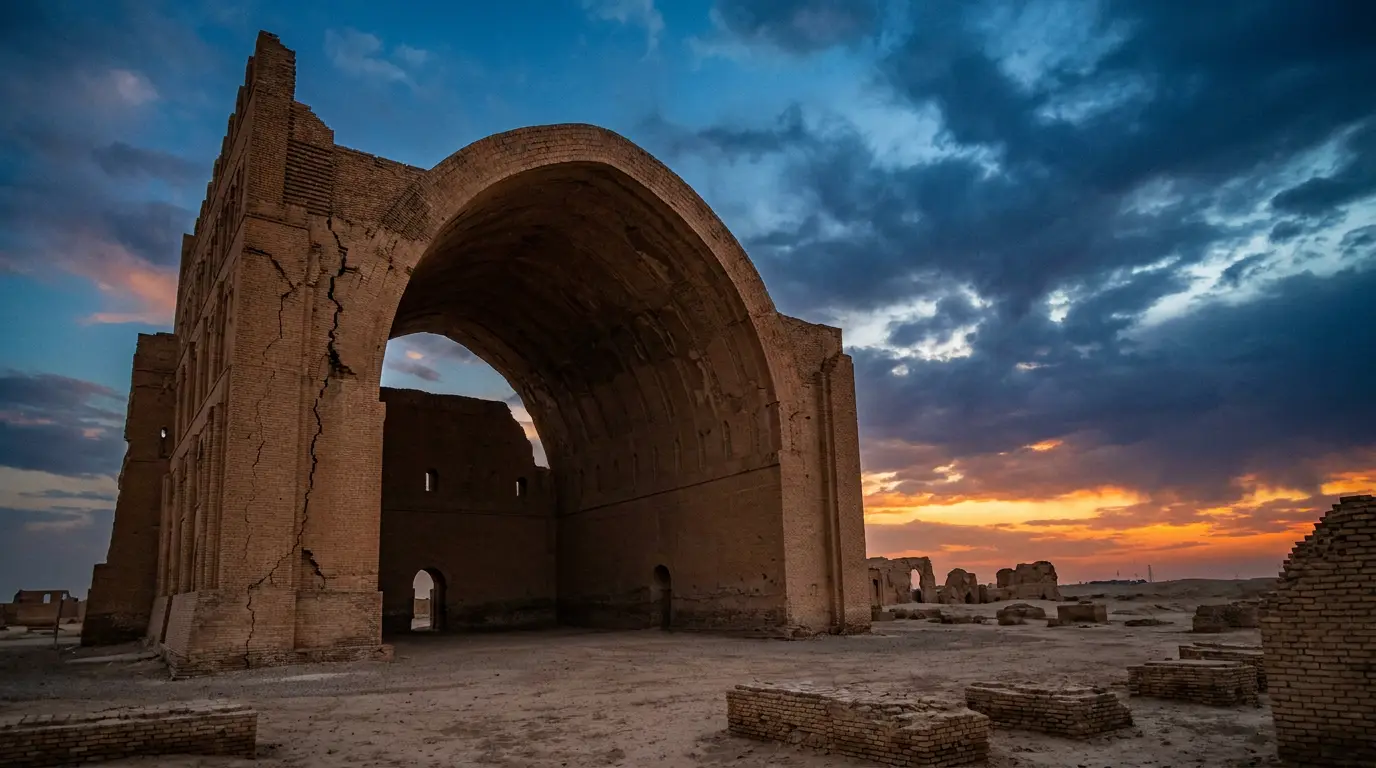
The Sasanian capital, Ctesiphon on the bank of the Tigris, was one of the greatest cities of the world of that age. Its enduring symbol is the vast brick vault known as the 'Taq-e Kasra'; the tallest unbuttressed brick arch of the ancient world, part of which still stands. Sasanian art — from the bas-reliefs to the gold-woven fabrics and silver vessels — became a model whose influence is seen from Byzantium to China and then upon early Islamic art. Even so, historians are not of one mind as to how much of these reforms truly belonged to Khosrow.
The Great War and the Arab Conquest
At the beginning of the seventh century, the ancient rivalry of Iran and Byzantium reached its ruinous peak. Khosrow II Parviz won dazzling victories — Sasanian armies took Syria, Palestine, and Egypt and captured Jerusalem — but the Byzantine emperor, Heraclius, with a bold campaign into the heart of the Sasanian realm, turned the tide. This twenty-year war wore both empires down severely: the treasuries were emptied and the people grew weary. Khosrow II was at last deposed and killed by those close to him, and the court sank into the turmoil of succession.
At precisely that moment, in the south, in the Arabian peninsula, a new and unified force was rising, driven by the newly emergent religion of Islam. In the fateful Battle of Qadisiyya — around 636 to 638 CE — the great Sasanian army was defeated and Ctesiphon fell. The last resistance was broken at the Battle of Nahavand. The last King of Kings, Yazdegerd III, fled the capital and for years retreated toward Khorasan in order to gather a force to reclaim the crown.
Yazdegerd was at last killed in 651 CE near Merv — according to the well-known account, at the hand of a miller, in flight and alone. With his death, the Sasanian dynasty and the last Iranian empire before Islam came to an end. But the collapse of the state did not mean the erasure of Iran; the language, the historical memory, the art, and the concept of 'Iranshahr' remained, and in a new civilization — this time in conjunction with Islam — they took shape anew. The world stood on the threshold of a great transformation.
⚖ Contested points
- The exact date of the construction of the 'Taq-e Kasra' at Ctesiphon is not certain; some attribute it to Khosrow I (sixth century) and others to earlier periods.
- The actual degree of centralization of the Sasanian state and the attribution of the fiscal and military reforms to Khosrow I are matters of debate; a number of historians trace part of these transformations back to the reign of his father, Kavad. Likewise, our knowledge of Mazdak's teachings derives mainly from the tongue of his opponents and is uncertain.
Sources
- Encyclopædia Iranica — «Arsacids», «Sasanian Dynasty», «Ardašir I», «Šāpur I», «Ḵosrow I», «Ērānšahr», «Gondēšāpur», «Mani», «Mazdak»
- Encyclopædia Britannica — «Parthia», «Sasanian dynasty», «Battle of Carrhae», «Khosrow I», «Ctesiphon», «Yazdegerd III»
- Touraj Daryaee, Sasanian Persia: The Rise and Fall of an Empire
- کتیبهٔ شاپورِ یکم بر کعبهٔ زرتشت (نقشِرستم)