Sea and Fire: The Great Campaign of Xerxes
In the spring of 480 BCE, the son of Darius, Xerxes (in Greek, “Xerxes”), set in motion an army from the heart of Asia toward the west on a scale that seemed unprecedented even in the magnificent memory of the Achaemenids. The aim was to punish the Greek cities of the mainland that had stood against his father in the Ionian Revolt and at the Battle of Marathon (490 BCE). The Greek sources, above all Herodotus, speak of bridging the strait of the Hellespont with ships and of digging a canal across the Athos peninsula—an image in which an imperial will prevails over geography itself.
The figures that Herodotus gives for this army—hundreds of thousands and even millions of men—are today reckoned by historians to be exaggerated; more cautious estimates speak of a great army, but on a realistic scale. Even so, what is certain is the breadth of the mobilization of the empire’s multiethnic forces: from the Medes and Persians to the Egyptians, Babylonians, and the Greeks of Asia Minor, alongside a fleet whose backbone was formed by the Phoenicians and the Ionians.
The Straits: Thermopylae, Salamis, Plataea
The first great clash took place in the narrow pass of Thermopylae, where a coalition of Greeks under the command of Leonidas the Spartan blocked the advance of the imperial army for days. In the end, according to the Greek account, a side path brought about the encirclement and defeat of the defenders; the stand of that small band later became a symbol of resistance, yet on the field the way to Athens lay open, and the city was evacuated and burned.
The fate of the campaign was decided not on land but on water. In the Strait of Salamis, the Greek fleet—by the stratagem of Themistocles the Athenian—drew the imperial navy into narrow waters and inflicted a heavy defeat upon it in a hard-fought battle. The Athenian poet Aeschylus, himself a witness of that generation, brought this victory to the stage through the voices of Persian mourners in his play «The Persians»—a literary and at the same time partisan document. Xerxes returned with part of the army and entrusted command of the remaining forces to his general Mardonius. The following year, in 479 BCE, the land defeat at Plataea and, according to the tradition, almost simultaneously the naval defeat at Mycale, effectively ended the imperial military presence on the Greek mainland.
The Broken Mirror: The Account of the Victors
It must be said plainly that our picture of these wars derives almost entirely from the sources of the victorious side. Herodotus wrote decades after the event, and Aeschylus staged his scenes for an Athenian audience; both in an atmosphere in which “the victory of the free Greek over Eastern despotism” had become one of the foundations of Greek self-awareness. In this account, Xerxes often takes on the figure of a proud and wrathful tyrant who whips the sea.
Against this, the Iranian and Babylonian evidence—inscriptions and administrative and chancery tablets—tell of a relatively conventional and capable ruler who governed a vast domain for years, raised buildings at Persepolis, and continued the fiscal and administrative apparatus of his forefathers. This difference between the “Xerxes of the Greeks” and the “Xerxes of the documents” is a contested point; what can be said with caution is that the defeat in Greece was, rather than a collapse of the empire, a withdrawal on a distant frontier.
Two More Centuries: A Hidden Zenith and the Turmoil of the Court
Contrary to the impression that sometimes settles in after the Greek account, the defeat in Greece did not mean a rapid decline of the Achaemenids. The empire remained, for nearly a century and a half after Salamis, the greatest power of the known world and even influenced the game of Greek politics; Persian gold and diplomacy became a decisive weight in the long internal war of the Greeks—the Peloponnesian War—and at last, in the “King’s Peace” (387/386 BCE), the Great King himself became the arbiter of the Greek order.
Within, however, the institution of kingship was subject to recurring tensions: struggles over succession, court intrigues, and revolts of the satraps, which sometimes joined hands. Cyrus the Younger, the king’s brother, rose in revolt in pursuit of the crown and was killed at Cunaxa (401 BCE); the return of his Greek mercenaries from the heart of the empire—which Xenophon recounted in the «Anabasis»—taught the Greeks that this giant, for all its splendor, was vulnerable before a disciplined army.
Alexander: Granicus, Issus, Gaugamela
In the middle of the fourth century, a new power arose in northern Greece: Macedon, under the leadership of Philip and, after him, his son Alexander. In 334 BCE, Alexander crossed the Hellespont with an army not very large but seasoned and cohesive. His first great victory, on the bank of the river Granicus, opened the gateway to Asia Minor. The following year, at Issus, in the northeastern corner of the Mediterranean, he stood face to face with Darius III and shattered his great army; the king’s family was taken captive, and Darius himself fled the field.
The decisive battle took place in 331 BCE on the plain of Gaugamela, in northern Mesopotamia. Darius III had this time assembled a larger army and an open field for his chariots and cavalry, but Alexander’s tactics and a rupture that appeared in the Persian array once again brought about defeat. Darius fled yet again, and the gates of Babylon and Susa, two of the great capitals of the empire, were opened to the Macedonian conqueror.
The Fire of Persepolis and the Death of Darius
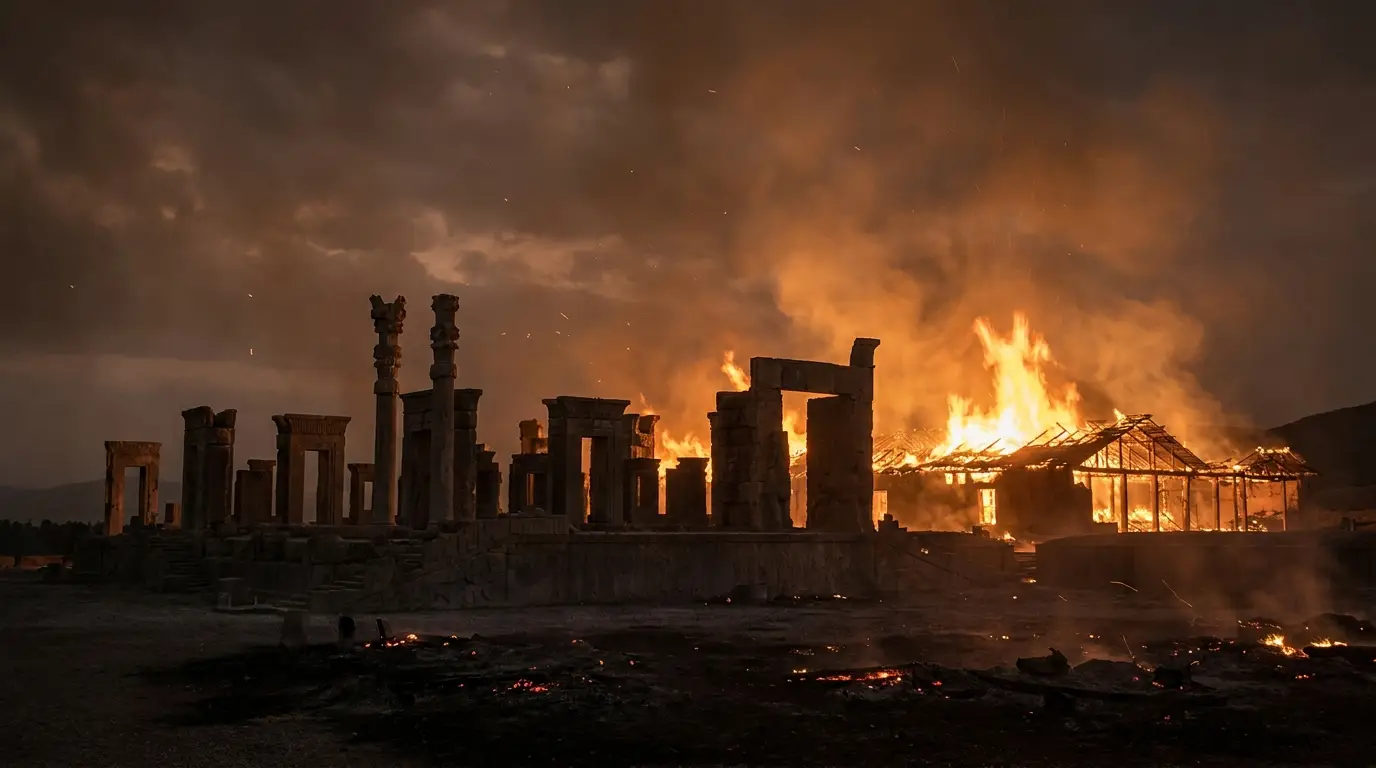
In 330 BCE the magnificent palaces of Persepolis were consumed by fire. The ancient sources offer two differing accounts: one, a sudden conflagration in the wake of a drunken feast, at the instigation of a woman named Thais; the other, a deliberate decision to proclaim symbolically the end of Achaemenid kingship and to avenge the burning of Athens in the previous generation. Archaeological excavations confirm signs of a widespread fire, but as to the motive, a definitive judgment is not possible; this is one of the most contested moments in the ancient history of Iran.
Darius III, the last Achaemenid Great King, was seized in his flight toward the east by one of his own satraps, Bessus, who laid claim to the throne, and was then killed. According to the sources, Alexander buried his body with royal honors and presented himself as the legitimate heir to the throne. Thus the dynasty that had begun with Cyrus came to an end after about two centuries.
The Uninvited Heir and the Enduring Legacy
In his later years, Alexander more or less adopted the manner of the Iranian kings: Persian dress, the ceremonial of the court, and the controversial effort to compel his Macedonian companions to the customs of Iranian deference. Through the numerous marriages of his commanders to Iranian women, at Susa, he sought to fuse the two ruling elites. This policy met with resistance among the veteran Macedonians and kept Alexander’s figure divided between “Greek conqueror” and “Eastern king.”
In 323 BCE, Alexander died in Babylon at the age of thirty-three, without leaving a firm successor. His vast empire was swiftly divided among his generals—the Diadochi—and given over to war. A large part of the Iranian plateau and Mesopotamia fell to Seleucus and his dynasty, the Seleucids; Hellenizing rulers who founded new cities and spread the Greek language and culture among the ruling strata, but who could never attain a lasting mastery over the whole of the old Achaemenid expanse.
Even so, what came to an end was a dynasty, not an identity. The satrapal structure, the religious rites, and the memory of Iranian rule lived on beneath the shell of Hellenism. From the east, from the heart of the Parthian plains, a new lineage was rising that reclaimed the Iranian heritage—the Arsacids, who will write the story of Iran’s revival in the chapter to come.
⚖ Contested points
- Herodotus’s figures for the size of Xerxes’s army (hundreds of thousands to millions of men) are reckoned by present-day scholars to be greatly exaggerated; more realistic estimates consider a large but far smaller army to be probable.
- The image of Xerxes diverges clearly between the Greek sources (a proud tyrant) and the Iranian-Babylonian evidence (a conventional and capable ruler); the Greek picture must be regarded as the partisan account of the victors.
- The motive for the burning of Persepolis in 330 BCE is contested: the account of a drunken conflagration versus the hypothesis of a deliberate and symbolic decision; archaeological evidence confirms the fire but does not make the motive certain.
Sources
- Encyclopædia Iranica — «Xerxes», «Darius III», «Alexander the Great», «Persepolis», «Greece i–iii»
- Encyclopædia Britannica — «Xerxes I», «Greco-Persian Wars», «Battle of Salamis», «Alexander the Great», «Seleucid Empire»
- هرودوت، «تواریخ» (دفترهای هفتم تا نهم) — منبعِ اصلی اما جانبدارانه
- آیسخولوس، «پارسیان» (۴۷۲ پ.م)
- گزنفون، «آناباسیس»
- Pierre Briant, From Cyrus to Alexander