The Night the World Changed Hands
In the autumn of 522 BCE, the vast empire that Cyrus had founded and Cambyses had expanded trembled on the brink of collapse. Cambyses, the conqueror of Egypt, died mysteriously on his way back to Persia; and in the land of Media a man had ascended the throne who called himself Bardiya, the brother of Cambyses. Then, in a mountain fortress named Sikayauvatish, a band of Persian nobles stormed the palace and killed that king. At the head of the conspirators stood a young man from a junior branch of the Achaemenid house: Darius, son of Hystaspes.
According to Darius's own account, the slain king was not the true Bardiya but a false magus named Gaumata, who had exploited his resemblance to the real prince and usurped the crown — while the genuine Bardiya had already been secretly put to death earlier by Cambyses. In the official narrative, then, Darius was not a usurper but the restorer of legitimate order and the avenger of the royal house.
An Inscription That Binds Evidence to Claim
Darius set down this narrative not on perishable paper but on the breast of a mountain. On a high cliff at Behistun, along the great road from Hamadan to Babylon, he ordered a relief carved: himself with his foot upon the breast of the fallen Gaumata, facing a row of nine rebel kings in chains, and the winged Faravahar spread above. Beside the image a long text was incised in three scripts and three languages — Old Persian, Elamite, and Akkadian — recounting the story of his rise to power and his suppression of the revolts.
Yet this very document, which is the principal pillar of our narrative, is itself the central point of a long-standing controversy among scholars. Many read Behistun as the "victor's account": a text Darius composed to legitimize his own coup. The serious question arises that perhaps Bardiya was the genuine prince and Darius himself the usurper, who fabricated the legend of the false magus to conceal this truth. We have no independent source that confirms or refutes his account; what we know comes largely from the mouth of the one who won that struggle.
The Year of Nineteen Battles
The death of the king set a spark to the tinder of discontent. According to Behistun, in the months that followed, the lands rose in revolt one after another: Babylon twice, Media, Elam, Parthia, Margiana, and even Persia, the homeland of the dynasty itself. Darius claims that in a single year he fought nineteen battles and defeated nine rebel kings. Loyal generals and soldiers covered vast distances to extinguish the fire of each revolt before it could spread.
This bloody suppression, sometimes accompanied by harsh public punishments of the rebel leaders, consolidated the foundations of the empire. Darius emerged from this crisis not with a throne but with a sword; and it was precisely this brush with collapse that spurred him to architecture — the architecture of an order that could no longer fall apart so easily.
The Machine of Empire
Darius's genius lay not in conquest but in organization. He divided the vast realm into large administrative units, the satrapies, and set over each a satrap (province-governor) who was the king's representative in administering the region. But so that the power of these local rulers should remain controllable, alongside each satrap he placed an independent military commander and scribes, to serve as the eyes and ears of the center and to maintain a balance.
Darius standardized the system of taxation: each satrapy, according to its capacity and wealth, paid annually a fixed amount of tribute, often in silver or goods. To keep this financial cycle running smoothly, an enduring gold coin called the daric was struck, which, alongside the silver coin known as the siglos, guaranteed the commercial credit of the empire across an expanse from India to the Aegean Sea. This financial unity was, in its time, an achievement with few parallels.
The Royal Road and the Flight of the Couriers
An empire of such extent, without instruments of communication, was doomed to fragment. Darius organized a network of roads, the most famous of which was the "Royal Road"; a long route that, according to Herodotus, ran from Sardis in western Anatolia to Susa, one of the capitals, and along which regular stations and caravanserais were established.
Along this road flowed an astonishing courier system called the chapar: fresh riders with horses at the ready waited at each station, took the dispatch from the weary courier, and at once galloped on to the next station. In describing these couriers, Herodotus penned a sentence that centuries later became the motto of one of the world's postal services: neither snow, nor rain, nor scorching heat could keep them from the swift completion of their task. Alongside the roads, Darius also brought to completion a canal between the Nile and the Red Sea, which made possible direct navigation from Egypt to the Persian Gulf.
Parsa, the City of Ceremony
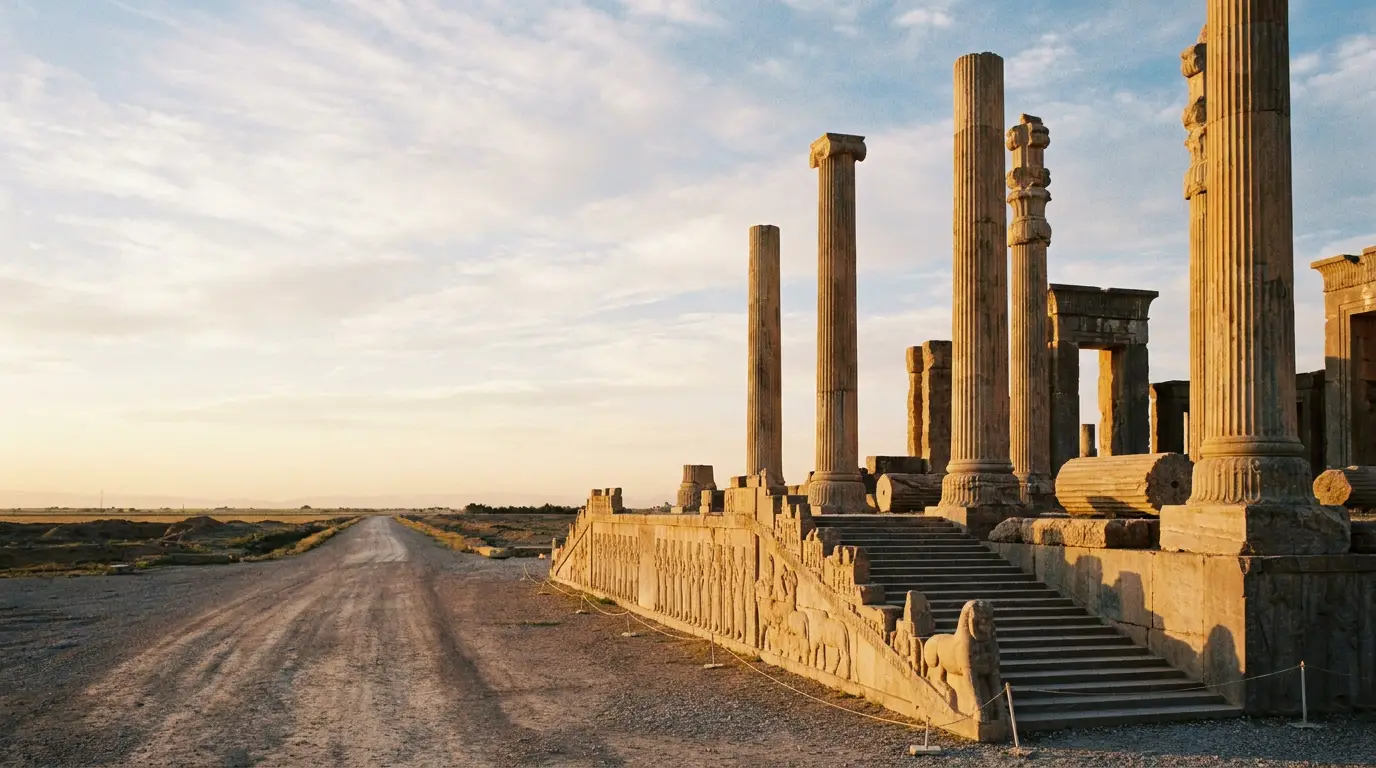
Darius wanted a stage worthy of his empire. In the heart of Persia, upon a vast stone terrace cut and leveled from the mountain, he founded a ceremonial city which the Persians called Parsa and the Greeks named Persepolis — "the city of the Persians." This was not an administrative center but a showcase of royal splendor; a place for rites, especially a festival thought to be linked to Nowruz, the beginning of the year.
The masterpiece of Parsa was its columned audience hall, the Apadana; a hall with tall stone columns and capitals in the form of two-headed bulls. On the stone staircase of the Apadana an unrivaled relief is carved: a long procession of delegates of the empire's various nations, each, in the dress and adornment particular to his own land, bearing a gift toward the king. The Medes an horse, the Armenians a golden vessel, the Babylonians cloth, the Indians gold. This image, more than a scene of tribute-collecting, presents an idealized picture of the unity of peoples under the shadow of the king — a propaganda in stone for an order that Darius wished to make appear eternal.
The Key That Unlocked the Lost Script
The Behistun inscription, beyond its historical value, found a second destiny that Darius could never have imagined. In the nineteenth century CE, the cuneiform script had remained silent and illegible for thousands of years. A British officer named Henry Rawlinson, at the risk of his life, climbed the high cliff of Behistun and copied the trilingual text.
Because the same message was written in three languages, Behistun took on a role like that of the Egyptian Rosetta Stone: a bridge for decipherment. The work of Rawlinson and other scholars on this text led at last to the reading of Old Persian cuneiform and then Akkadian, and opened the door of the lost civilizations of Mesopotamia and ancient Iran to the modern world. Thus the political propaganda of a king became, twenty-five centuries later, the key to re-reading an ancient history.
The First Sparks of the Western Fire
The western frontier of the empire, where the Persian realm met the Greek cities of Anatolia, was pregnant with a conflict that shaped the fate of the ancient world. Around 499 BCE, the Greek-inhabited cities of the Ionian coast, which were under the command of Persian satraps and client rulers, rose in revolt. Athens and Eretria came to their aid from across the sea, and in an assault the city of Sardis, the center of the western satrapy, was set ablaze.
Darius crushed the revolt, but did not forget the burning of Sardis. In 490 BCE he sent a naval force to Greece. This force, after punishing Eretria, landed on a coastal plain named Marathon, near Athens. There the Athenian soldiers, fewer in number but greater in motivation, in an astonishing battle defeated part of the great imperial army and drove them into the sea.
By the measure of the vastness of the Achaemenid Empire, Marathon was a small defeat; but in the memory of the Greeks it became a symbol of resistance. Darius was preparing for a greater campaign when death gave him no respite. The grudge and the unfinished work he passed, together with the crown, to his son Xerxes — a man who wished, with a force the size of the entire empire, to bring both sea and land to their knees. The storm was only just on its way.
⚖ Contested points
- The most central controversy: was Darius the restorer of legitimate order or a usurper? His account at Behistun, that the slain king was "Gaumata the magus" (not the true Bardiya), may be the victor's propaganda to conceal the killing of the genuine prince and the illegitimate seizure of the throne. No independent source exists to render a definitive judgment.
- Darius's religious connection to Zoroaster is not certain: the inscriptions praise Ahura Mazda but make no mention of Zoroaster; whether the Achaemenid kings were Zoroastrian is a matter of debate.
- Many of the details of the Battle of Marathon and of the Royal Road and the chapar come from Herodotus, who was a Greek writer and at times partisan; the figures and certain scenes should be viewed with caution.
Sources
- Encyclopædia Iranica — «Darius I», «Bisotun», «Persepolis», «Achaemenid Dynasty», «Satrap»
- Pierre Briant, From Cyrus to Alexander (2002)
- Amélie Kuhrt, The Persian Empire: A Corpus of Sources (2007)
- Encyclopædia Britannica — «Darius I», «Battle of Marathon», «Persepolis»
- Herodotus, The Histories (Books III, V, VI) — با ملاحظهٔ سوگیریِ منبع
- M. A. Dandamaev, A Political History of the Achaemenid Empire (1989)
- کتیبهٔ بیستون (Behistun Inscription)