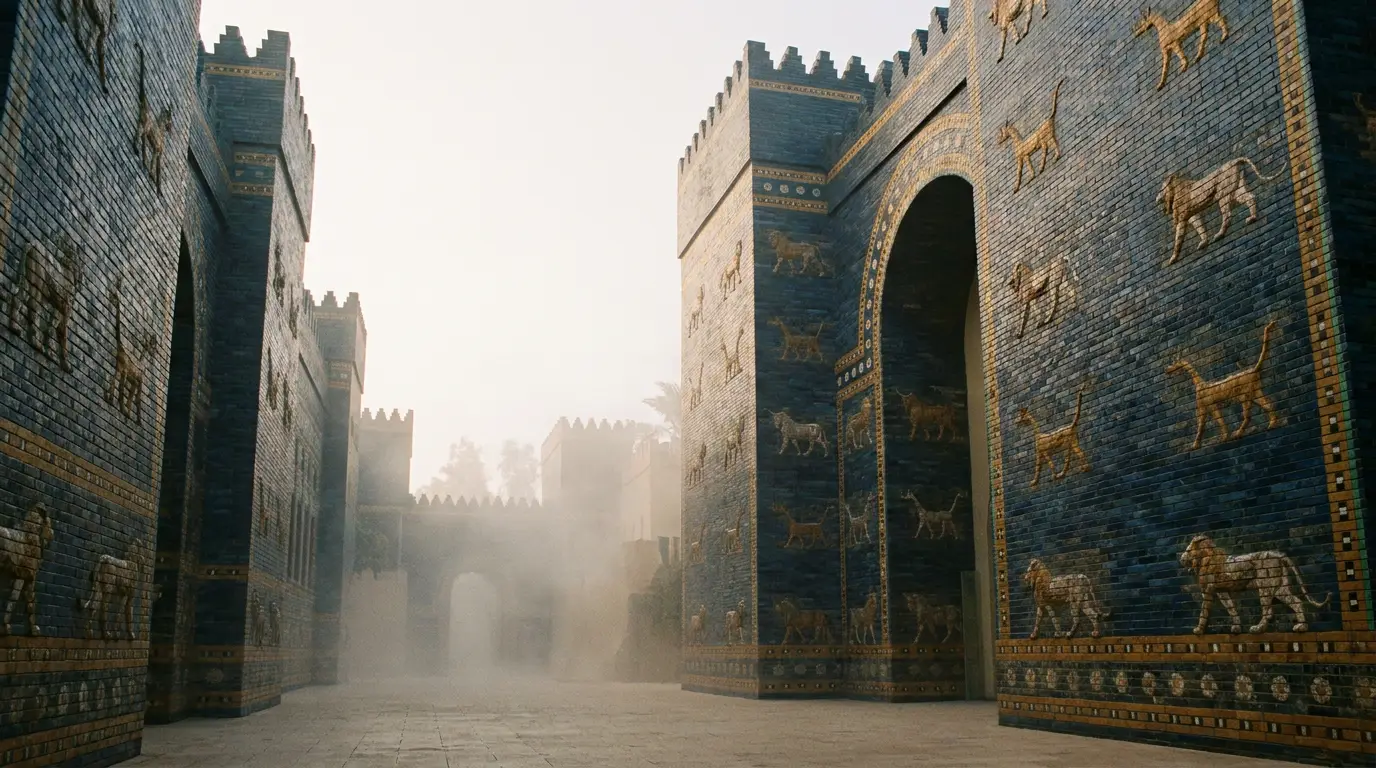
The Night Babylon Fell Without Bloodshed
On the evening of an autumn day in 539 BCE, the city of Babylon — the greatest metropolis of its age, with its high walls, its fabled gardens, and the ziggurat temple of Esagila — was poised to pass another night in apparent security. Yet the river Euphrates, flowing through the heart of the city, seemed quieter than ever. The Persian army, commanded by a general acting on behalf of Cyrus, had defeated the Babylonian forces near Opis, and now the gates of the capital were crumbling before the invaders.
According to the Nabonidus Chronicle — a Babylonian cuneiform document composed close to the time of the events — the city fell to Cyrus's forces without any great battle. Nabonidus, the last king of Babylon, who had spent years in the oasis of Teima in Arabia and had estranged the priests of the god Marduk, fled and was subsequently captured. The famous account by Herodotus and Xenophon of diverting the course of the Euphrates so that the soldiers could enter through the dry riverbed is a captivating tale; but many scholars today regard it as a literary embellishment rather than a reliable report.
A few days later, Cyrus himself entered the city. According to the official Babylonian text, green branches were spread before his feet, and he presented himself not as a foreign conqueror but as the chosen one of Marduk, the great god of Babylon. This scene — a peaceful entry in place of a bloody slaughter — became the foundational image of the manner of rule of the man whom the world would call "Cyrus the Great."
From Anshan to the Fall of Media
Cyrus rose from the Achaemenid house, a dynasty that ruled over the land of Persia and the ancient city of Anshan in the southwest of the Iranian plateau. In the Cyrus Cylinder he calls himself "son of Cambyses, the great king, king of Anshan" and a descendant of Teispes — a lineage rooted in a small kingdom that lived in the shadow of the powerful empire of Media.
Around 550 BCE, Cyrus rebelled against Astyages, king of Media. The ancient sources offer varying accounts of this event — including the legends of Astyages's dream and the prophecy of his overthrow at the hands of his grandson — but the Nabonidus Chronicle gives a clearer report: the Median army rebelled against Astyages, took him captive, and handed him over to Cyrus. Cyrus seized the Median capital, Hagmatana (Ecbatana), and carried its treasures to Anshan. In this way the kingdom of Media was not wholly destroyed but absorbed into a new body of power; the Medes retained a lofty standing throughout the fledgling empire.
Croesus and the Gold of Lydia
The victory over Media suddenly made Cyrus a neighbor of the great powers of the west. In Anatolia lay the wealthy kingdom of Lydia, ruled by Croesus — a king whose name had become synonymous in the Greek world with boundless wealth, and who was said to have introduced the first gold and silver coins.
Croesus, anxious about the rise of a new power in the east, marched his army across the river Halys. An indecisive battle took place at Pteria, and Croesus, supposing that the campaigning season had ended, dismissed his army and returned to his capital, Sardis. But Cyrus, contrary to the custom of the age, pursued him in the depths of winter. In the battle near Sardis — where, according to Herodotus, Cyrus deployed pack camels against the Lydian cavalry so that the horses would bolt at their scent — Lydia was defeated, and Sardis fell after a brief siege (around 547–546 BCE). The fate of Croesus himself remains uncertain; some accounts speak of his being burned on a pyre and then rescued, but these scenes have the color of legend. What is firm is that with the fall of Lydia, all of Anatolia and the Greek cities of the Aegean coast were joined to the Persian realm.
The Model of Rule by Tolerance
What distinguished Cyrus's empire from the conquerors before him was not mere vastness, but the manner of holding it together. The Assyrian kings had earlier deported rebellious peoples and destroyed their temples; Cyrus chose another path. He honored the local gods, kept the native elites in their place, and presented himself in each land in the language of that very people — in Babylon the chosen one of Marduk, in the eyes of the Jews the instrument of the will of Yahweh.
The most famous example of this policy is the permission granted to the exiled Jews to return to Jerusalem. According to the Book of Ezra in the Old Testament, Cyrus decreed that the Jews exiled to Babylon — who had been driven from their land half a century earlier by Nebuchadnezzar — should return to Judah and rebuild the Temple of Jerusalem. In the Jewish tradition, Cyrus took on a liberating figure, and the Book of Isaiah called him "messiah" (the anointed of the Lord) — a rare title for a non-Jewish ruler. This policy of restoring peoples and gods is also reflected throughout the Babylonian texts of that period.
The Cyrus Cylinder and the Myth of the "First Charter of Human Rights"
In 1879, archaeologists found in the ruins of Babylon a clay cylinder covered in Akkadian cuneiform script, today preserved in the British Museum. This "Cyrus Cylinder" speaks in the name of the king himself: it calls Nabonidus an unworthy king who had angered Marduk, and Cyrus a deliverer whose hand the god had taken and brought to Babylon without war. The text speaks of returning the statues of the gods to their sanctuaries and of the homeless peoples returning to their homes.
In the twentieth century, this cylinder became a global symbol. In 1971, during the celebrations of two thousand five hundred years of monarchy, the Pahlavi regime named it "the first charter of human rights in the world," and a replica of it was presented to the United Nations. This image was so powerful that it endures in the minds of many to this day.
But present-day scholars — among them Irving Finkel, the cuneiform specialist of the British Museum — consider this label incorrect and anachronistic. The cylinder in fact belongs to a literary genre long established in Mesopotamia: the "foundation inscription," a text that Babylonian and Assyrian kings placed in the foundations of temples during their reconstruction in order to make their kingship appear legitimate and just. There is no mention in it of individual rights, universal freedom, or the equality of citizens; these concepts were born far later in the history of human thought. The historical worth of the cylinder is great in its own right — a document of Cyrus's policy of tolerance and realism — but reading it as a declaration of human rights is a projection of modern ideals onto an ancient text.
Death on the Eastern Frontier
Cyrus spent the final years of his life guarding the vast frontiers of the empire. The great danger came not from the west but from the northeast — from the steppes of Central Asia, where the nomadic tribes of the Scythians and the Massagetae lived beyond the river Jaxartes (Syr Darya). Cyrus marched out to secure this frontier and was killed in those very lands around 530 BCE.
The most renowned account of his death comes from Herodotus: a battle with Tomyris, queen of the Massagetae, whose son had been killed at the hands of the Persians and who had sworn to glut Cyrus with blood; and finally, after the defeat of the Persians, she plunged the head of Cyrus into a skin filled with blood. But this is only one of several differing ancient accounts — Xenophon reports a peaceful death in bed — and most scholars regard the story of Tomyris as semi-legendary. What is more certain is his death on the field of battle on the eastern frontier; his body was brought back to Persia.
Pasargadae and the Tomb of the Founder
Cyrus came to rest at Pasargadae, the first ceremonial capital of the Achaemenids in the heart of Persia. His tomb — which still stands today — is a building simple and majestic: a stone chamber with a sloping roof, atop six broad steps that rise like a stepped pyramid. Against the ornate palaces of those who came after, this tomb speaks in its own simplicity.
Centuries later, when Alexander of Macedon reached Persia, he stood before the tomb of Cyrus and — according to the account of Arrian and Strabo — read upon it an inscription that named itself Cyrus, founder of the Persian empire, and that asked the passerby not to begrudge this mound of earth. Alexander, finding the tomb plundered, ordered its restoration — the homage of one conqueror to another, across the span of two centuries.
Legacy and the Shadow of the Future
Over the span of three decades, Cyrus built from a small kingdom in Persia the greatest empire in human history up to that day — a realm from the Aegean Sea to the borders of India. He was not only a conqueror but the architect of a model of rule that gathered diverse peoples and religions beneath a single crown; a model that his successors would extend and consolidate.
After the death of Cyrus, the throne passed to his son Cambyses — a king who added Egypt to the empire and stretched the reach of the Achaemenids to the banks of the Nile, but whose short and turbulent reign led to a crisis that finally set another man upon the throne: Darius, who recast the organization of the empire and made the name of the Achaemenids eternal upon the Behistun inscription. But that is the tale of another chapter.
⚖ Contested points
- The story of diverting the course of the river Euphrates to enter Babylon (Herodotus and Xenophon) is, in the view of most scholars today, a literary embellishment; the Babylonian cuneiform sources (the Nabonidus Chronicle) report the fall of the city without a great battle.
- The label "first charter of human rights" for the Cyrus Cylinder is, in the view of scholars such as Irving Finkel and the Encyclopaedia Iranica, anachronistic and incorrect; the cylinder belongs to the Mesopotamian tradition of "foundation inscriptions," and this label is a construct of the modern era (especially the Pahlavi propaganda of 1971).
- The account of Cyrus's death in battle with Tomyris of the Massagetae (Herodotus) is semi-legendary and disputed; other ancient sources (including Xenophon) provide differing accounts — even a peaceful death in bed.
- The fate of Croesus after the fall of Sardis (being burned on a pyre and a miraculous rescue) is largely regarded as legendary.
Sources
- Encyclopaedia Iranica, "Cyrus the Great" (M. A. Dandamayev)
- Encyclopaedia Iranica, "Cyrus Cylinder"
- Irving Finkel (ed.), The Cyrus Cylinder (British Museum)
- Pierre Briant, From Cyrus to Alexander: A History of the Persian Empire
- Encyclopaedia Britannica, "Cyrus the Great"
- Herodotus, The Histories, Book I
- Xenophon, Cyropaedia
- Nabonidus Chronicle (ABC 7), British Museum
- The Hebrew Bible: Ezra and Isaiah 40–45