A Land Between Mountain and Desert
First, picture the land. A vast, high plateau, hemmed in by mountain ranges that rise around it like walls: the Zagros in the west, the Alborz in the north. In its center stretch salt-crusted, merciless deserts where scarcely a plant will grow. This land is not generous. Rain falls seldom and water is dear. Yet on the slopes and in the valleys, where a stream comes down from the mountain, life becomes possible — and humankind, from the earliest times, has chosen those places.
Thousands of years before any king sat upon a throne, on these very slopes of the Zagros, one of humanity's oldest experiments in taming nature took place. At sites such as Ganj Dareh in western Iran, archaeologists have found traces of the first herding of goats and cultivation of grain, dating back ten thousand years. At Susa and at Tepe Sialk near Kashan, painted pottery has emerged from the earth: bowls on which a mountain goat with crescent horns is drawn so simply and so precisely that it still arrests the eye. These are the signatures of peoples whose names we do not know, yet whose hands still speak to us.
Elam: A Civilization Forgotten
Out of these beginnings, in the southwest of the plateau, rose the first great civilization of this land: Elam. A realm with two hearts — Susa on the plain of Khuzestan, near Mesopotamia, and Anshan in the highlands of Fars, the place that would later be called Persia. This duality of plain and mountain left its mark across the whole history of Elam; a civilization that looked at once toward the river civilizations and was rooted in the Iranian highlands.
The Elamites possessed something that set them apart from their neighbors: their language. The Elamite language, as far as we know, is related to no other known tongue. It belongs neither to the Semitic family of Mesopotamia nor to the Indo-European family that would later come to the plateau. Linguists call it a "language isolate" — a lonely island in the sea of languages. The Elamites first wrote this language in a pictographic script and later in cuneiform, and these very writings, though many of them remain undeciphered, are a window onto a world that would otherwise stay mute.
The history of Elam is, above all, the history of a long-enduring struggle; a thousand-year duel with the civilizations of Mesopotamia. The Sumerians, Akkadians, Babylonians, and Assyrians, one after another, fought with Elam, made pacts with it, traded with it, and were at times defeated by it. Around 2000 BCE, it was these Elamites who fell upon the city of Ur, that brilliant Sumerian center, and brought the Third Dynasty of Ur to an end — a blow whose memory lived on for centuries in the lamentations of Mesopotamia. Elam was no passive margin, but a leading player in the drama of ancient civilization.
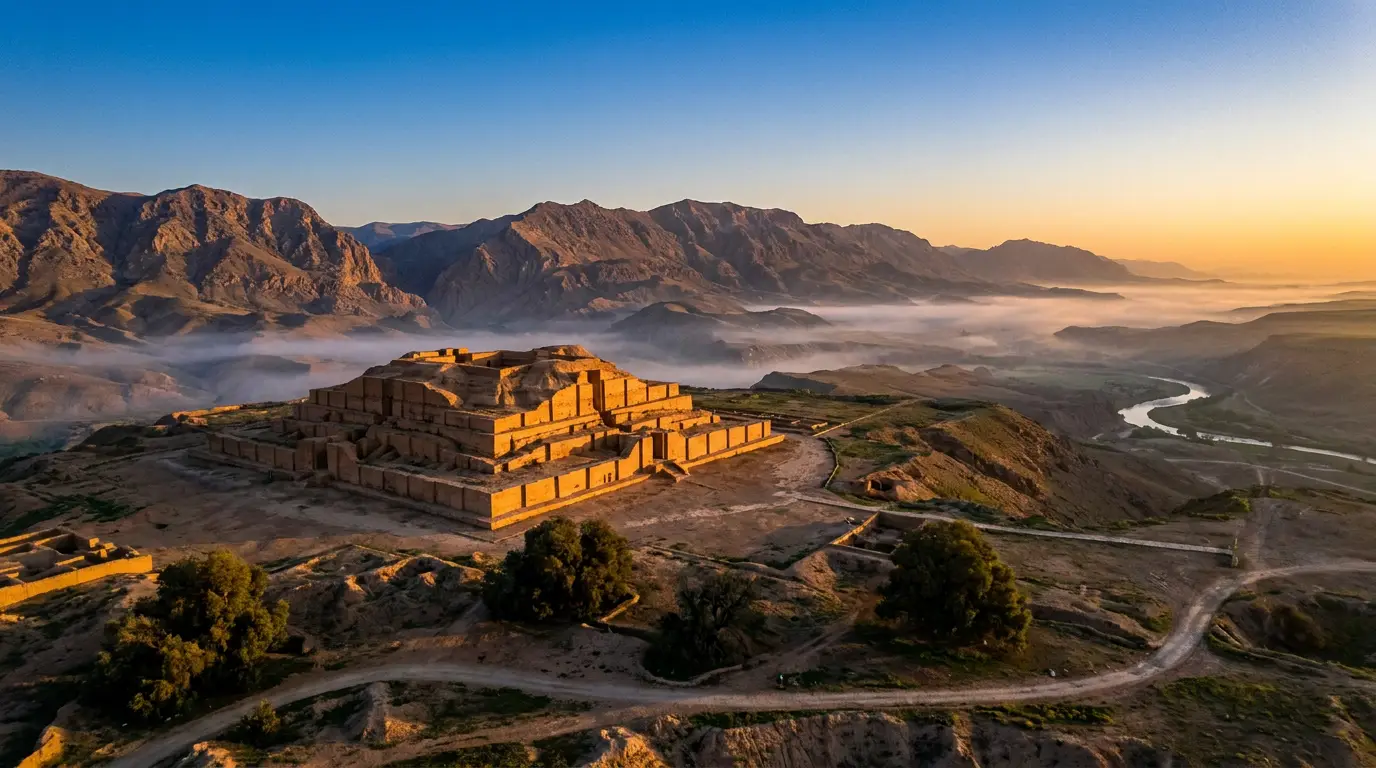
The greatest monument of this civilization still stands today on the plain of Khuzestan: the ziggurat of Choghā Zanbil. In the thirteenth century BCE, Untash-Napirisha, one of the most powerful kings of Elam, founded a ritual city and raised this immense structure at its center to serve as the temple of Inshushinak, the guardian god of Susa. The ziggurat was built of millions of baked bricks, and on many of the bricks the builder's name and the dedication of the structure are inscribed in Elamite cuneiform; a library of clay that forms the temple's very walls. This structure, the best-preserved ziggurat outside Mesopotamia, is a testament to the skill and ambition of a civilization the world had long forgotten.
That Night at Susa
But no splendor is eternal. In the seventh century BCE, Assyria had reached the height of its power — a military and merciless empire that made everything from Egypt to the Persian Gulf tremble. Elam, riven from within by family conflicts and factions struggling over the throne, was no longer the unified rival of old. The kings of Assyria exploited this weakness.
In the year 646 BCE, Ashurbanipal finished off Elam for good. His army took Susa and plundered it. The reliefs that survive from his palace at Nineveh — and are kept today in museums — show the scene in horrifying detail: Assyrian soldiers striking at the ramparts of Susa with picks, flames licking up from the temples, and captives being led away in rows. In his inscriptions, Ashurbanipal boasts extravagantly that he destroyed the sanctuaries, carried off the statues of the gods into captivity, and even opened the tombs of Elam's former kings and scattered their dust. This, in the worldview of that age, was not merely the destruction of the body; it was an attempt to annihilate the soul of a nation — so that neither its dead might rest nor its gods endure.
And yet one must be cautious. The language of Assyria's royal inscriptions is the language of propaganda, steeped in ritual exaggeration. Archaeologists have shown that Susa was not in truth destroyed and that over the following decades and centuries it came to life again; indeed it later became one of the capitals of the Achaemenid empire. What collapsed in 646 was not the city of Susa but the unified political power of Elam. Elamite civilization did not die; it endured in the region's peoples, language, and gods and, remarkably, passed to new heirs who were arriving from the mountains.
The Newcomers: Iranian-Speaking Peoples
At the very time that Elam was in decline, the plateau was witnessing another great transformation; one slower but more profound. Over the course of the second millennium BCE, groups of nomadic, pastoral peoples, whose language was a branch of the great Indo-European family, streamed into this land from the north and northeast. They called themselves "Arya" — a word that became the root of the name "Iran." This migration was not a sudden, overnight event; it was a slow, multigenerational process, a blend of migration and intermingling with the plateau's earlier inhabitants.
These newcomers had two great branches whose names endured in history: the Medes in the west and northwest of the plateau, and the Persians in the south, in that ancient land of Anshan. Their language, gods, and way of life differed from those of the native Elamites, but over time these two worlds became interwoven. The Persians inherited many of the administrative and cultural traditions of Elam; a bond that would later become apparent at the Achaemenid court. The identity we call "Iranian" was born of this very mingling: not of a pure race, but of the meeting of mountain and plain, nomad and settler, newcomer and native.
The Medes and Ecbatana
Among these Iranian-speaking peoples, the first to build a great power were the Medes. They gathered in the western Zagros and around a city called Ecbatana — present-day Hamadan. The name of the Medes first appears in Assyrian inscriptions; those same Assyrians who for years raided the land of Media to seize horses and tribute. The Medes were at first peoples scattered among tribes and local leaders, but the continual pressure of Assyria gradually compelled them to unite.
Much of what we know about the rise of the Medes has come down to us from Herodotus, the Greek historian. He recounts the story of a line of kings: Deioces, who first gathered the Medes under a single command and built Ecbatana with seven walls of different colors; then Phraortes; then Cyaxares, who was the most powerful of them; and finally Astyages. Herodotus presents the picture of a powerful and organized kingdom. But here one must be very cautious; for Herodotus's account, written nearly two centuries after those events, is mingled with legend and Greek literary patterns and does not everywhere agree with other evidence.
The truth is that from the Medes themselves, unlike the Elamites and later the Achaemenids, almost no written document has survived. We have no Median royal archive, no Median inscription. What we have is the account of outsiders — Assyrians and Greeks — and scattered archaeological findings. For this reason, one of the serious debates among scholars today is whether the "Median empire" was truly a centralized and unified state, as Herodotus says, or rather a loose, weak coalition of tribes and local leaders under the leadership of Ecbatana. This question still has no definitive answer, and honesty demands that we keep it open.
The Fall of Assyria
Whatever we do not know about the internal structure of Media, one great achievement of theirs is beyond doubt: their decisive role in the overthrow of Assyria. That fearsome empire which for centuries had drenched all its neighbors, Elam and Media among them, in dust and blood, itself one day came to its own end — and its end was swift and terrible.
At the close of the seventh century BCE, Cyaxares, king of Media, allied himself with Nabopolassar, the founder of the Neo-Babylonian empire. These two powers, one from the eastern mountains and the other from the south of Mesopotamia, caught Assyria between them. In the year 612 BCE, the allied army of Media and Babylon assailed Nineveh, the magnificent capital of Assyria, and razed it to the ground. The fall of Nineveh was so well remembered that its echo can be found even in ancient Hebrew and Greek texts. Only a few generations after Ashurbanipal had boasted over the ruins of Susa, his own capital met the same fate. The wheel of history had turned, mercilessly.
With the collapse of Assyria, the ancient Middle East was divided among several powers, and Media became one of its great players; a vast realm that stretched from the Zagros to Anatolia. For the first time, the Iranian-speaking peoples were not the victims of other empires but themselves the builders of a regional power. The dawn of the plateau was nearing midday.
On the Threshold of Cyrus
But the story of Media had a surprising end. Astyages, the last king of Media, had a grandson on his daughter's side; a prince of the house of Persia who ruled in the land of Anshan. His name was Cyrus. Around the year 550 BCE, Cyrus rose in revolt against Astyages, and in a battle in which even part of the Median army joined him, he defeated his own grandfather and took Ecbatana.
Thus power passed from the Medes to the Persians — yet not as a foreign conquest, but rather as a transfer of leadership between two branches of one great family. Cyrus kept many of the Medes alongside the Persians within his apparatus, and the Greeks for a long time simply called the Achaemenids "the Medes," so interwoven were these two. What Cyrus inherited — a military organization, the experience of ruling a vast land, and the ancient blend of the Elamite and Iranian heritage — was the springboard for his leap toward something the world had never seen before.
Here, on the threshold of the rise of Cyrus, the first chapter of our story comes to an end. The plateau had now left its childhood behind. Elam had given its splendor and gone, but its legacy had remained alive. The Medes had overthrown Assyria and built the first great Iranian power, but they themselves were stepping aside. And out of all this — out of that scorched plain and that stubborn mountain, out of that mingling of languages and gods and peoples — there arose a man whose name history has never forgotten. But that is the story of the next chapter.
⚖ Contested points
- The degree of centralization and unity of the "Median empire" is sharply disputed among scholars; Herodotus's account of an organized state is supported by little independent evidence, and some regard Media rather as a loose coalition of tribes.
- The chronology of the Median kings, and even the historical reality of some of them (such as Deioces), rests largely on Herodotus's account, which was written nearly two centuries after the events and mingled with literary elements.
Sources
- Encyclopaedia Iranica, "Elam" / "Media" / "Medes" / "Cyrus II"
- Encyclopaedia Iranica, "Choghā Zanbil" / "Susa"
- Herodotus, The Histories, Book I (read critically)
- D. T. Potts, The Archaeology of Elam (Cambridge University Press)
- Encyclopædia Britannica, "Media" / "Elam" / "Cyaxares"
- Amélie Kuhrt, The Ancient Near East c. 3000–330 BC (Routledge)