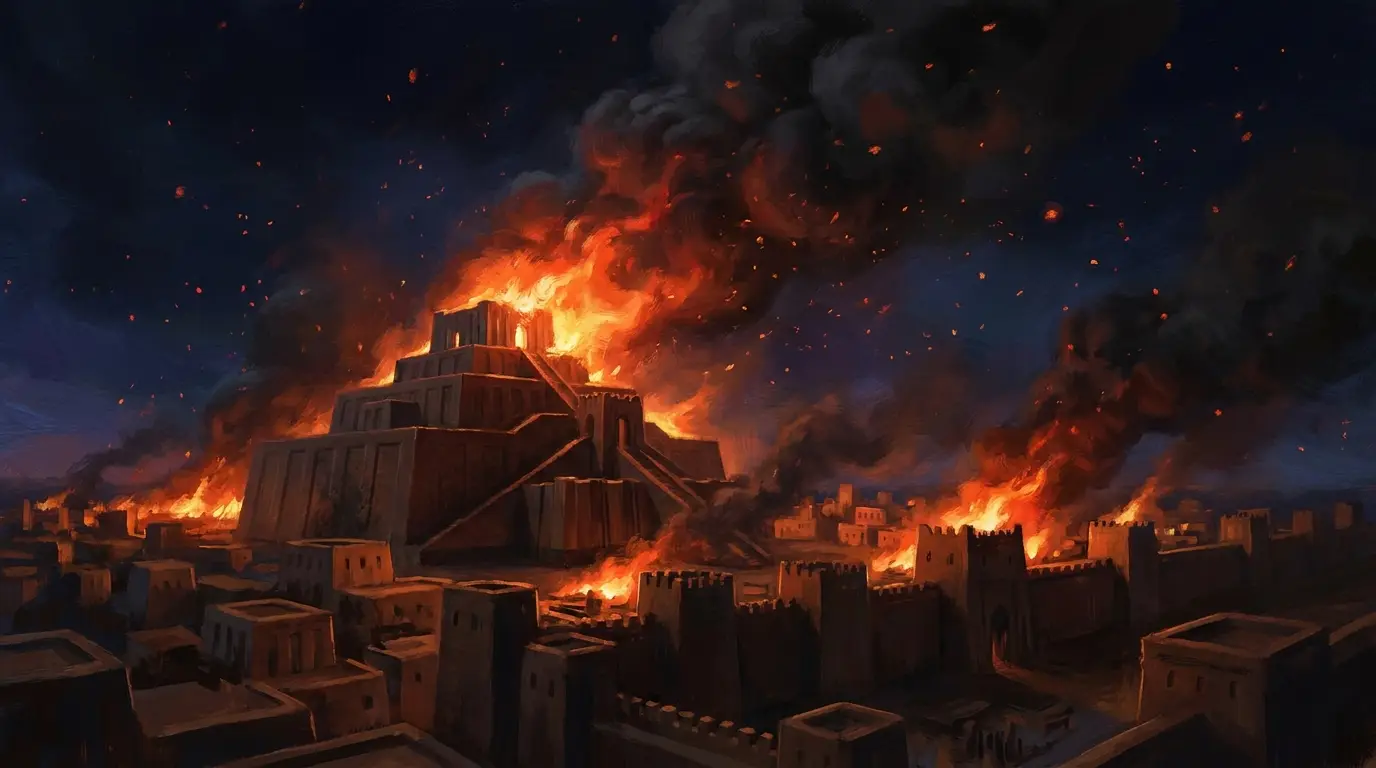
It was night, and the city was burning. In the year 646 BCE, in Susa, the ancient capital of Elam, fire climbed up from the rooftops and thick smoke hid the stars from sight. The army of Ashurbanipal, king of Assyria, had come from the west; from that arid land between two rivers that had warred for centuries with this mountain kingdom. The soldiers poured into the temples. They bound the statues of the gods upon their backs and carried them away. They broke open the tombs of Elam's kings and dragged the bones into captivity — an act that, even in that merciless age, was the mark of a fury beyond mere victory.
The Assyrian king himself, later, ordered this scene carved in stone upon the walls of his palace in Nineveh, and wrote in his inscriptions that he had reduced Susa to ruins and scattered salt upon its soil so that nothing would grow there again. This is the conqueror's account; the account of one who sought to overthrow not only a city, but the memory of a civilization. Yet the soil of the plateau held a memory more stubborn than salt. Less than a century after that night, Assyria itself was reduced to ashes, and from that same scorched plateau rose a people who built a new world.
This book is the story of that soil.
A true story of Iran — neither a pleasing legend for the comfort of the heart, nor an indictment to condemn this side or that. A story that strives to tell things as they were: glorious where there was glory, bitter where bitterness passed, and uncertain where the evidence is silent. This is the emblem of this book: «Truth, with evidence — against forgetting.» So everything you read rests, as far as possible, upon a witness: upon a clay tablet, a carving in stone, pottery and bone and inscription, and upon what today's scholars have read back from these traces.
But history, especially ancient history, is not the land of firm certainties. Much of what we know about the past is a cautious estimate drawn from scattered and at times contradictory evidence. For this reason, in this book we draw a clear line between two things: between what evidence supports and what is legend or conjecture. Wherever our knowledge is shaky, or scholars disagree about something, we will show it openly — not out of a wish to sow doubt, but out of honesty. This honesty is itself part of the story; perhaps its most beautiful part.
Why «against forgetting»? Because forgetting always lies in wait. Sometimes it comes with fire and salt, as it came to Susa. Sometimes with the rewriting of history to suit the powerful. And sometimes, most dangerous of all, with indifference; with each generation leaving the names and sufferings and achievements of those who came before unread. Writing documented history is an effort to ensure that what happened is not lost once more, and this time forever.
In the pages ahead, a long journey lies before us. We begin at the dawn of the plateau; from an age when the first cities of southwestern Iran were rising and the Elamites were building, on the edge of Mesopotamia, a civilization that endured for millennia. From there we come to the migration of Iranian-speaking peoples, to the rise of the Medes and Hegmataneh, to Cyrus and that astonishing empire which, for the first time, gathered the known world beneath one sky. Then we pass through the Greeks and Alexander, the Parthians and the Sasanians, the coming of Islam and that profound transformation, the splendor and devastation of the Mongols, the Safavids and Qajars and the Constitutional Revolution, down to our own turbulent age.
This is not the history of a nation in its simple sense; it is the history of a land that has taken in many peoples and languages and religions, and from this blend made something we call «Iran.» It is a story of continuity and rupture, of devastating defeats and incredible revivals. We tell it without veils; with love for the land, but without flattery toward power.
Now, let us return to the beginning. To a plateau that as yet knew no king and wrote no script. To a dawn out of whose heart everything arose.
⚖ Contested points
- The account in Ashurbanipal's inscriptions of the complete destruction of Susa and the scattering of salt upon it is the ritual and exaggerated language of Assyrian royal propaganda; archaeological evidence shows that Susa was not entirely wiped out and was resettled in later periods, so the true extent of the destruction should be read with caution.
Sources
- Encyclopaedia Iranica, "Susa" / "Elam"
- Encyclopaedia Iranica, "Aššurbanipal"
- Encyclopædia Britannica, "Ashurbanipal" / "Elam"
- D. T. Potts, The Archaeology of Elam (Cambridge University Press)